


Personal Income Tax Guide in Bangladesh (Finance Act 2026)
August 1, 2026 | by Mohmmed Ismail Miah

Assessment Year (AY): 2027–2028 | Income Year: 1 July 2026 – 30 June 2027

Personal Income Tax Guide in Bangladesh (Finance Act 2026)
Assessment Year (AY): 2027–2028 | Income Year: 1 July 2026 – 30 June 2027
Introduction of Bangladesh income tax framework
Income Tax Act 2023 (ITA 2023), as amended by the Government from time to time, is the legal framework of imposing income tax in Bangladesh. The Ministry of Finance (MoF) and the National Board of Revenue (NBR), the primary tax regulator, issue statutory orders, general orders, special orders, clarifications, and notifications from time to time to support the tax legislation
Imposition of tax :
Chargeability of tax: Income tax is charged on a taxpayer’s taxable income that is derived in accordance with the provisions of Income Tax Act 2023 during an income year by applying the tax rates prescribed by Finance Acts or Ordinances enacted by the Government of Bangladesh
Residency: In general, a company which is incorporated in Bangladesh will be treated as a resident for tax purposes. Furthermore, any company, trust, fund, an entity or any artificial juridical person created whose control and management are situated wholly in Bangladesh will also be treated as a resident for tax purposes. Any person not being a resident is a non-resident for tax purposes.
Personal Income Tax Guide :
This guide summarizes the key provisions for individual taxpayers under the Income Tax Act, 2023, as amended by the Finance Act, 2026. The Finance Act 2026 increased the general tax-free threshold and revised the individual tax slabs.
1. Who Must File an Income Tax Return?
An individual should file an income tax return if they are required under the Income Tax Act, including where they:
- Have taxable income above the tax-free threshold.
- Own a Taxpayer Identification Number (TIN) where return filing is mandatory.
- Require Proof of Return Submission (PRS) for specified services.
- Meet any other statutory filing requirement prescribed by the National Board of Revenue (NBR).
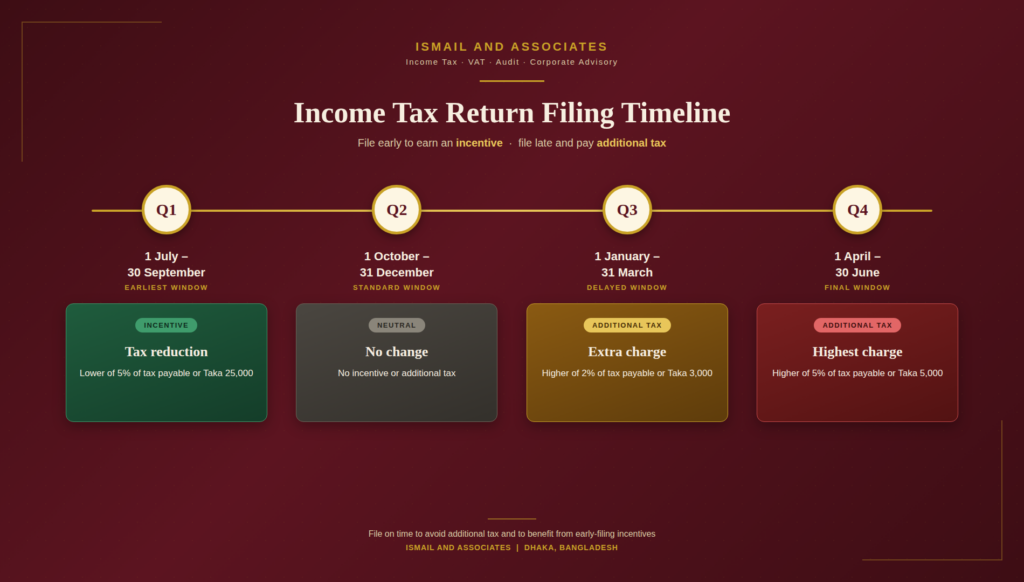
Timeline of submission of tax returns :
| File tax returns between.. | Incentive or additional tax |
| 1 July to 30 September | Incentive: Lower of 5% of tax payable or Taka 25,000 |
| 1 October to 31 December | No incentive or additional tax |
| 1 January to 31 March | Additional Tax: Higher of 2% of tax payable or Taka 3,000 |
| 1 April to 30 June | Additional Tax: Higher of 5% of tax payable or Taka 5,000 |
2. Tax-Free Income Limits
| Category | Tax-Free Limit (BDT) |
| General Individual | 400,000 |
| Women & Senior Citizens (65+) | 425,000 |
| Persons with Disabilities | 500,000 |
| Gazetted Freedom Fighters | 5,50,000 |
3. Individual Income Tax Slabs (Finance Act 2026)
| Taxable Income Slab | Tax Rate |
| First BDT 400,000 | 0% |
| Next BDT 300,000 | 10% |
| Next BDT 400,000 | 15% |
| Next BDT 500,000 | 20% |
| Next BDT 2,000,000 | 25% |
| Remaining Income | 30% |
4. Example Calculation
Annual Taxable Income: BDT 1,500,000
| Slab | Tax (BDT) |
| First 400,000 @ 0% | 0 |
| Next 300,000 @ 10% | 30,000 |
| Next 400,000 @ 15% | 60,000 |
| Remaining 400,000 @ 20% | 80,000 |
| Total Income Tax | 170,000 |
Imposition of tax on salary :
Scope of taxable income: Taxable income in Bangladesh is defined on the basis of tax residency of the taxpayer. Scope of personal income generally includes income from employment excluding, exempted income.
Residency: For individuals, residency depends on the period of stay in Bangladesh. An individual is a resident if the individual resides in Bangladesh for:
183 days or more in any income year; or
• 90 days or more in an income year and that person has also previously resided in Bangladesh for a period of 365 or more days during the four preceding years.An individual not meeting the above conditions is a nonresident.
For the following cases:
• 30 June following the end of the income year if filing tax returns for the first time.
• within 90 days from the date of return to Bangladesh for individuals who stay outside Bangladesh for higher education, or on deputation, lien for employment with valid visa and work permit.
Assessment year: Assessment year is a twelve-month period commencing from the first day of July of a calendar year unless specific rules apply.
Income year : Income year is a period not more than twelve-months preceding the assessment year. For individuals, income year is 1 July to 30 June.
Proof of submission of return (PSR) ; Individual taxpayers are required to show PSR or a system generated certificate containing name and TIN for obtaining certain services or prior to embarking on certain activities.
Tax registration: Expatriate employees working in Bangladesh require work permits issued from the appropriate authority to obtain tax registration in Bangladesh.
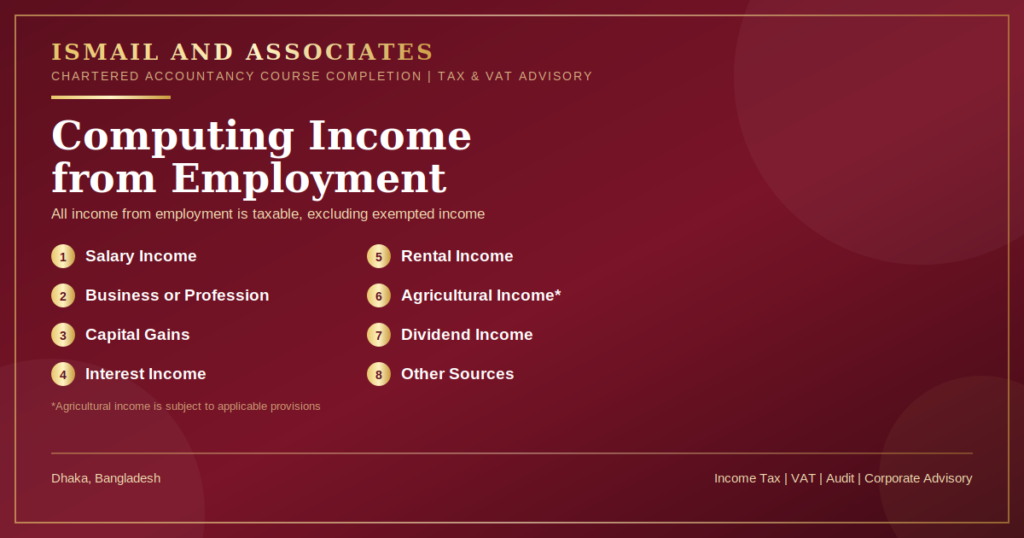
5. Computing income from employment: Income from employment includes all income from employment, excluding exempted income.
- Salary Income
- Business or Profession
- Capital Gains
- Interest Income
- Rental Income
- Agricultural Income (subject to applicable provisions)
- Dividend Income
- Other Sources
Business combinations :
Direct transfer of shares: Capital gain tax on direct transfer of shares, i.e. transfer of shares in a company incorporated in Bangladesh is well regularized. General capital gain computation rules are applicable
Indirect transfer of shares: Bangladesh tax legislation imposes capital gain tax on transfer of shares in a foreign company that directly or indirectly has interests in Bangladesh. Capital gain tax in Bangladesh is computed as a proportion of fair value of the assets in Bangladesh to the fair value of assets of the foreign company being sold. Offshore Indirect Transfer Rules, 2022 was issued with an aim to provide clear guidance on computation of fair value of assets in Bangladesh and of the foreign company as well as filing obligations of the selling shareholders and Bangladesh interest/entity. Additionally, the rules also provide exemptions to non-controlling shareholders and de minimis investments
As business combinations become familiar, tax legislation has clarified the scope of amalgamation and demerger along with the tax treatments of the underlying transactions
Amalgamation: The key aspects of amalgamation or merger include: • All the property and liabilities of the amalgamating companies become those of the amalgamated company. • For a Bangladeshi amalgamated company, shareholders holding at least 75% of the shares in the amalgamating companies (excluding shares already held by the amalgamated company or its subsidiary) become shareholders of the amalgamated company. • For a foreign amalgamated company, shareholders holding at least 75% of the shares in the amalgamating foreign companies that hold shares in a Bangladeshi company (excluding shares already held by the amalgamated company or its subsidiary) become shareholders of the amalgamated company. • Qualified amalgamations and dem
Demerger : The key aspects of demergers include: • All the property and liabilities of the demerging company become those of the demerged company. • For a Bangladeshi demerged company, shareholders holding at least 75% of the shares in the demerged company become shareholders of the resulting company. • For a foreign demerged company, shareholders holding at least 75% of the shares in the demerged foreign company that hold shares in a Bangladeshi company become shareholders of the resultant company.
Capital assets: Personal belongings like gold, silver, diamonds, coins, antiques, paintings, digital coins and club memberships are now capital assets. Specifically, gold, silver, diamonds and coins are subject at reduced tax rate of 5%.
Business Income: CIT rate
Capital Gain: CGT rate :Capital gain tax rate for: Companies, trust, AoP – 15% Others 15% on shares of listed company 15% on other assets if held for more than 5 years, otherwise slab rate.
Business Income/Loss : Business income if selling price, insurance value, salvage value or compensation (up to acquisition cost) exceeds tax written down value; Business loss if selling price, insurance value, salvage value or compensation (up to acquisition cost) is less than tax written down value.
Capital Gain/Loss : Higher of selling price, fair market value, insurance value, salvage value or compensation, as applicable Less acquisition cost, Less any development cost, and Less any transaction costs.
Income from financial property : Income from financial property is generally taxed at the applicable tax rate of the taxpayer, except for dividend income earned by which is subject tax at 15% for individuals and 20% for others.
- Interest, profit and discounts from approved securities and issued debenture of Government or local authorities
- Interest or profit from debentures of company, deposits maintained with a bank or financial institution or financial asset, goods or scheme
- Dividend
Income inclusion : • Income from financial assets is included as include in the earlier of income year in which it is received or deposited with the taxpayer; and
• Accrual basis income from financial assets is not included in the computation of income.
Deductions : Expenses incurred only for the purpose of earning the relevant income are allowed as deductions including:
• Amount deducted from the receipts excluding any income tax by a bank or finance company;
• Interest paid on money borrowed solely for the purpose of earning “income from financial assets”; Following items are not allowed:
• Any interest payable outside Bangladesh on which withholding tax compliance has not been followed; • Expenses against income from such financial assets that are exempted from tax; and • Any expenditure of a capital or personal nature.
• Expense on which tax has not be deducted or deposited.
Income from rent ; Income from rent includes any rental income generated from any asset, irrespective of its rental nature, trade or business etc. excluding rental income from hotel, hostel, motel, resort or business property or land and building rented out by developers of Economic Zones and Hi-Tech Parks.Income from rent is generally taxed at the applicable tax rate of the taxpayer.
Income from other sources :
• Unexplained credits: Any unexplained credit in the taxpayer’s books.
• Asset growth mismatch: If taxpayer’s asset growth and expenditures exceed its declared income and acceptable receipts.
• Undervalued asset purchase: If taxpayer purchases an asset below fair market value.
• Contract related receipts: Compensation, fees, or benefits received due to cancellation or modification of a contract.
• Loan waiver: Any benefit from a loan waiver, whether monetary or not. Any waiver of borrowed funds from the family members shall not be treated as income, if converted to gift or disclosed in income tax returns of both parties.
• Paid-up capital without bank transfer: If an unlisted company receives paid-up capital without bank transfer.
• Advance, deposits or loans: If taken other than by bank transfer by an individual. If taken by bank transfer exceeding Taka 0.5 million remaining unpaid for 6 years. Subsequent repayment is deductible.
• Purchase of vehicle: If the cost of a company’s motor car or jeep exceeds 10% of its paid-up capital (including reserves and retained earning), 50% of the excess amount. Not applicable for companies engaged in vehicle rental business.
• Intangible and licensing income: Includes royalties, licence fees, technical service fees, and income from granting rights over intangible property. However, if the above is a regular activity of a taxpayer, such income shall be considered as ‘income from business or profession’.
• Government support: cash incentives received from the Government.
• Asset transfer income: Encompasses gains from transfer of self-created or natural assets, excluding specified resources and goodwill.
• Joint-venture (JV) profit: Profit distributed by a JV to its partners
• Grants and donations: Includes any form of donation, grant, or gift other than certain cases.
Abuse through tax arrangements ;
Misuse of tax arrangement is any arrangement, whether performed by the person affected or by any other person
• which creates one or more tax benefits, unless it is undertaken for a bona fide purpose; or
• which creates one or more tax benefits, unless the multiple arrangements or part thereof; are reasonably undertaken or created for a bona fide purpose. ITA 2023 defines Tax Benefit as
• Income tax avoidance or reduction;
• Relieve any person from the liability to pay income tax, or from the potential or prospective liability of future income tax;
• Avoiding, deferring or reducing, any tax liability, or any potential or prospective liability for future income tax; • Delay in payment of income tax; and
• Avoidance of requirement of deposit of tax deducted or collected at source. Arrangement is defined as all steps and transactions undertaken to affect a consent, agreement, planning, negotiation or memorandum of understanding. The DCT is empowered to initiate proceedings for any misuse of tax arrangement by a taxpayer and recover tax through:
• Income enhancement
• Correction of tax liability
• Adjustment of tax refund
• Correction of allowance, rebates etc.
• Any other means
6. Allowable Tax Credits and Rebates
Eligible investments may qualify for tax rebate under the Income Tax Act, subject to statutory limits.
Investment rebate ; Resident taxpayers and non-resident Bangladeshis may obtain credit on their investments. Lower of:
• 3% of total taxable income (excluding income subject to exemption, reduced tax rate or final tax liability and income from firm or association of persons), or
• 10% of actual investment as per Part 3 of 6th Schedule or
• Taka 750,000
FA 2026 changes ; Early encashment certain securities triggers clawback of investment rebate. Unit fund and mutual fund investment is uncapped.
Eligible investment :
Allowable/eligible investment for investment rebate includes:
Life insurance premium
Contribution to approved Provident Fund (both by the employee and employer)
Contribution to deposit pension scheme or monthly savings scheme amounting to maximum Taka 120,000 sponsored by a scheduled bank or a financial institution
Donation to a national level institution set up in memory of the “Liberation War”
Donation to government approved public welfare or educational institution
Donation to Zakat Fund/charitable fund established by or under Zakat Fund
Any sum invested in Government securities up to Taka 500,000
Any sum invested in unit certificates and mutual funds, ETF or joint investment scheme, unit certificate issued by financial institution, Investment Corporation of Bangladesh (ICB), fund manager etc.
Any new sum invested in shares of listed companies.
7. Documents Required
- e-TIN Certificate
- National ID/Passport
- Salary Certificate
- Bank Statements
- Investment Certificates
- House Property Information
- Rental Income Details (if any)
- Business Accounts (if applicable)
- Advance Tax/TDS Certificates
8. Important Compliance Points
- Maintain proper books and supporting documents.
- Collect tax deduction (TDS) certificates where applicable.
- File your return within the prescribed time.
- Keep copies of all supporting documents.
- Preserve records for future tax assessments.
9. Useful Official Resources
Key Changes Introduced by Finance Act 2026
- Increased general tax-free threshold to BDT 400,000.
- Revised progressive income tax slabs.
- Continued emphasis on proof of return submission and tax compliance.
Prepared by:
Ismail and Associates
Professional Tax, VAT, Accounting, Audit & Corporate Consultancy Services
RELATED POSTS
View all