



ISMAIL AND ASSOCIATES
Accountants | Tax, VAT, Audit and Corporate Advisory
BANK RECONCILIATION STATEMENT (BRS)
Concept, Reconciling Items, Process and Monthly Control Checklist
Prepared by Ismail and Associates
Mirpur, Dhaka, Bangladesh
1. Meaning of Bank Reconciliation
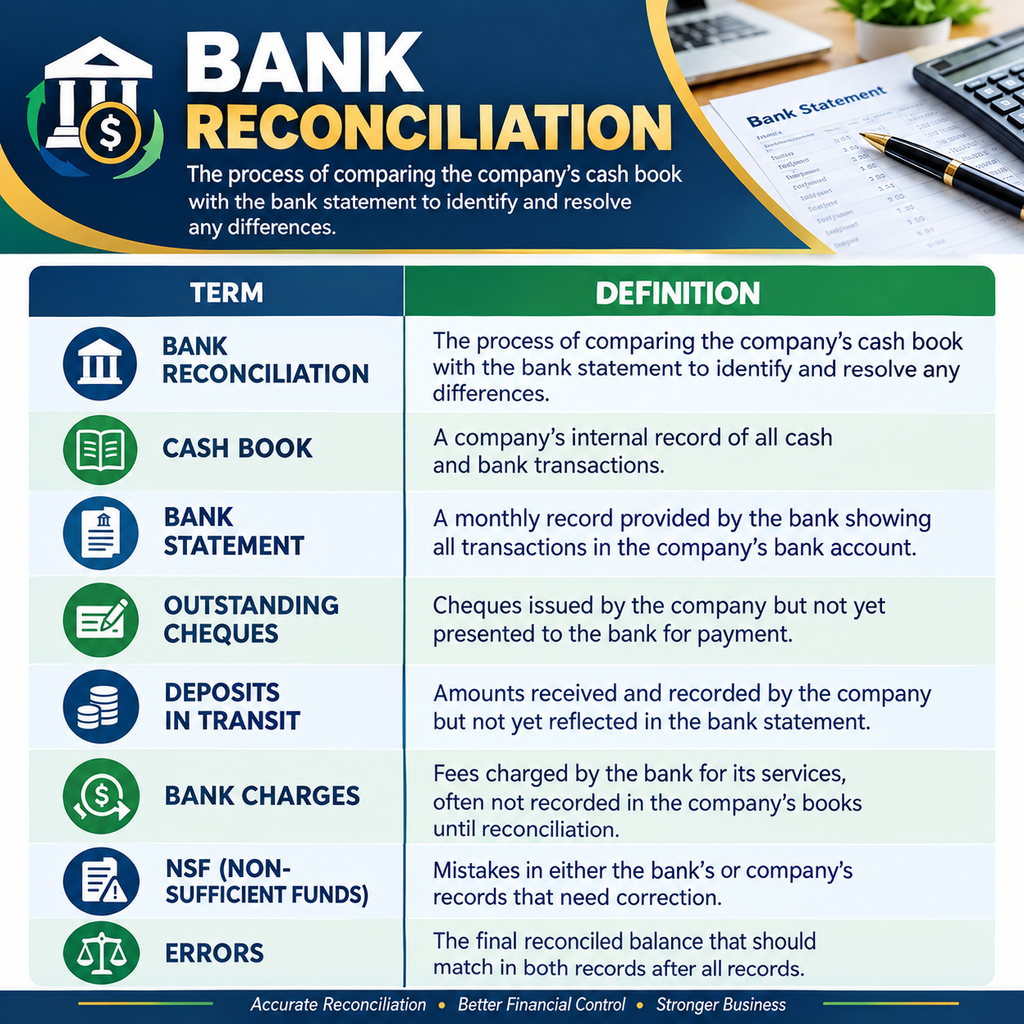
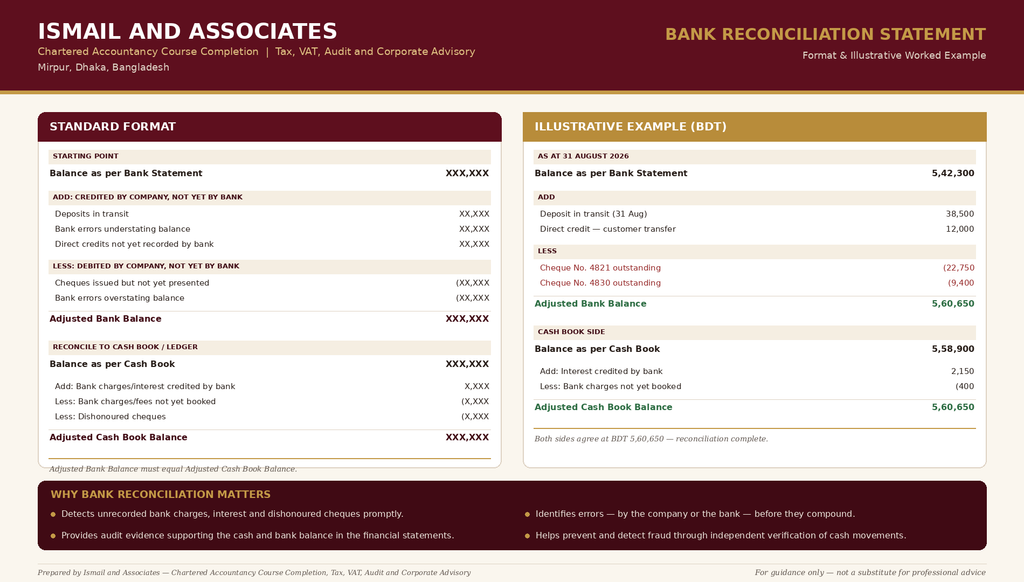
A Bank Reconciliation Statement (BRS) is an important accounting control used to reconcile the bank balance as per the Cash Book / Bank Book with the balance as per the Bank Statement. It explains the differences between:
- Bank balance as per Cash Book
- Bank balance as per Bank Statement / Bank Passbook
The objective is to identify timing differences, errors, omitted transactions, and unusual items.
Basic Formula
| Balance as per Cash Book ± Reconciling Items = Balance as per Bank Statement |
2. Main Reasons for Differences
| No. | Reconciling Item | Effect |
| 1 | Cheques issued but not yet presented | Cash Book balance may be lower |
| 2 | Cheques deposited but not yet credited by bank | Bank Statement balance may be lower |
| 3 | Bank charges not recorded in Cash Book | Bank Statement lower |
| 4 | Bank interest / credit not recorded in Cash Book | Bank Statement higher |
| 5 | Direct deposit by customer | Bank Statement higher |
| 6 | Direct payment by bank | Bank Statement lower |
| 7 | Standing order / payment | Bank Statement lower |
| 8 | Dishonoured cheque | Bank Statement lower |
| 9 | Collection by bank | Bank Statement higher |
| 10 | Errors in Cash Book | Depends on error |
| 11 | Errors in Bank Statement | Depends on error |
| 12 | Bank transfers not recorded | Depends on transaction |
3. Detailed Bank Reconciliation Process
Step 1 — Obtain Documents
Collect the following before starting reconciliation:
- Cash Book / Bank Book
- Bank Statement
- Previous month’s BRS
- Cheque register
- Deposit slips
- Payment vouchers
- Bank advices
- Bank charge statements
- Loan / LC / OD statements, where applicable
Step 2 — Compare Transactions
Match every transaction in the Cash Book against the Bank Statement. For example:
| Date | Particulars | Deposit | Payment | Balance |
| 01 Sep | Opening Balance | 10,00,000 | ||
| 03 Sep | Customer | 5,00,000 | 15,00,000 | |
| 05 Sep | Supplier | 3,00,000 | 12,00,000 |
Compare each item above with the corresponding entry in the Bank Statement.
4. BRS vs Cash Book Adjustment — A Key Distinction
Not every difference should remain only in the BRS. Certain items must first be recorded in the Cash Book itself before the BRS is finalised.
Items That Usually Require Cash Book Adjustment
- Bank charges
- Bank interest
- Direct deposits
- Direct payments
- Standing orders
- Loan instalments deducted by bank
- Dishonoured cheques
- Bank collection charges
After recording these items in the Cash Book, the BRS is then prepared for the remaining timing differences only.
5. Professional Monthly Bank Reconciliation Procedure
For a company such as New Asia Fashions Ltd., the following monthly control flow is recommended:
Bank Statement → Cash Book → Matching → Unmatched Items → Investigation → Adjustment → BRS → Review → Approval
Reconciliation Checklist
☐ Opening balance agrees with previous BRS
☐ All bank deposits matched
☐ All cheques / payments matched
☐ Outstanding cheques identified
☐ Deposits in transit identified
☐ Bank charges recorded
☐ Bank interest recorded
☐ Direct deposits recorded
☐ Direct payments recorded
☐ Dishonoured cheques recorded
☐ Bank errors identified
☐ Cash Book errors corrected
☐ Old outstanding items investigated
☐ Final BRS prepared
☐ Difference = Nil
☐ Reviewed by Accounts Manager
☐ Approved by CFO / Management
RELATED POSTS
View all