

A Complete Guide US Tax Filling for Individuals and Small Businesses
September 16, 2026 | by Mohmmed Ismail Miah

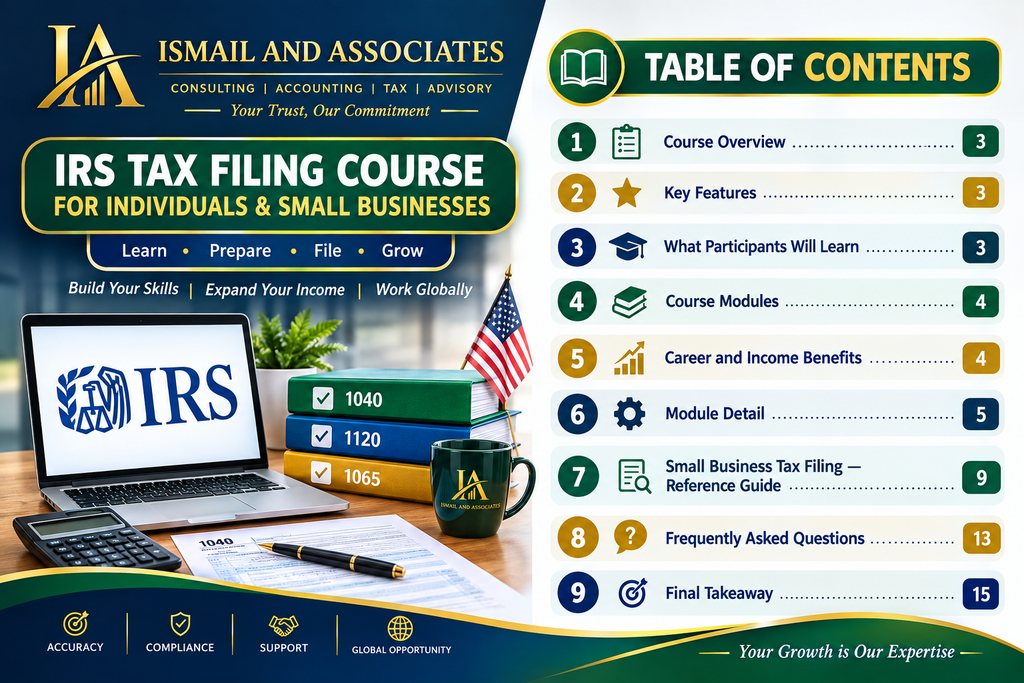
US TAX FILING
A Complete Guide US Tax Filling for Individuals and Small Businesses
Forms, Filing Methods, Payroll, Sales Tax, and Practitioner Certification
Table of Contents
1. Course Overview…………………………………………………………………………………………………………. 3
2. Key Features……………………………………………………………………………………………………………….. 3
3. What Participants Will Learn…………………………………………………………………………………………… 3
4. Course Modules…………………………………………………………………………………………………………… 4
5. Career and Income Benefits…………………………………………………………………………………………… 4
6. Module Detail……………………………………………………………………………………………………………… 5
7. Small Business Tax Filing — Reference Guide…………………………………………………………………….. 9
8. Frequently Asked Questions…………………………………………………………………………………………. 13
9. Final Takeaway…………………………………………………………………………………………………………… 15
1. Course Overview
The US Tax Filing course provides complete training on personal and business tax preparation. Starting with the U.S. tax system and IRS regulations, the program builds toward federal vs. state taxes, filing statuses, and the key forms used across individual, partnership, and corporate returns.
Scope of Coverage
- Individual returns (Form 1040) and self-employed reporting (Schedule C)
- Partnership and corporate filings (Forms 1065, 1120-S, 1120)
- Payroll taxes and state sales tax compliance
- E-filing, paper filing, and hands-on practice with tax software
- Live practice sessions, real-world case studies, and certification guidance (PTIN and EA)
2. Key Features
- Complete U.S. Taxation Coverage — Individual, business, payroll, and sales tax filing, with compliance built in throughout.
- Form-Focused Training — Step-by-step guidance on IRS forms: 1040, 1065, 1120-S, 1120, 941, 940, and state sales tax filings.
- Hands-on Tax Software Practice — Direct practice using TurboTax, ProConnect, TaxAct, and FreeTaxUSA.
- Certification Ready — PTIN registration and Enrolled Agent (EA) exam preparation included.
- Practical Learning — Real-world filing scenarios, live case studies, and a final practice exam.
3. What Participants Will Learn
- The U.S. tax system, the role of the IRS, and the distinction between federal and state taxation
- How to file individual returns (Form 1040, Schedule C), including deductions and credits
- How to prepare business returns for partnerships (1065), S-corporations (1120-S), and C-corporations (1120)
- Application of business deductions, depreciation rules, and available tax credits
- Federal and state tax compliance, amendments, and multi-state filings
- Filing extensions, correcting errors, and responding to IRS notices
- Running U.S. payroll taxes (Social Security, Medicare, FUTA, SUI) and filing Forms 941/940
- U.S. sales tax filing on a state-by-state basis, including nexus rules
- Proficiency with leading tax software: TurboTax, ProConnect, TaxAct, and FreeTaxUSA
- Preparation for PTIN registration and Enrolled Agent certification, including exam practice
4. Course Modules
- U.S. Tax System and Forms Overview
- Individual Tax Filing (Form 1040 and 1040-SR)
- Business Tax Filing (Forms 1065, 1120-S, 1120)
- Federal and State Tax Compliance
- Tax Filing Methods — Paper and E-File
- Tax Software Training
- US Payroll Run and Tax Filing
- US Sales Tax Filing, State-wise
- Final Practice Exam
5. Career and Income Benefits
- Earn High Income from Tax Preparation — U.S. tax professionals can charge $200–$600+ per return, depending on complexity (personal, business, or corporate).
- Yearly and Seasonal Income Opportunity — Tax season (January–April) brings concentrated demand, allowing a full year’s income to be earned in three to four months.
- Global Freelancing Market — U.S. tax filing services can be delivered remotely through platforms such as Fiverr, Upwork, and LinkedIn, serving clients worldwide.
- Business and Self-Savings — Business owners who complete the course can file their own taxes correctly, saving significantly on CPA fees.
- Long-Term Career Security — Tax is a recession-resilient field; with IRS, federal, and state tax knowledge, professionals maintain stable income and recurring clients.
6. Module Detail
6.1 U.S. Tax System and Forms Overview
Introduction to the U.S. Tax System
- Understanding the IRS and tax regulations
- Federal vs. state tax systems
- Role of the IRS and state tax agencies
- Filing statuses, tax brackets, and who must file
- Types of taxpayers: individuals, partnerships, corporations
Understanding Tax Forms and Business Entities
- Overview of Forms 1040, 1040-SR, 1065, 1120-S, and 1120
- Entity types: sole proprietorship, LLC, partnership, S-corporation, C-corporation
6.2 Individual Tax Filing (Form 1040 and 1040-SR)
Income, Adjustments, and Filing
- Types of income: wages, interest, dividends, capital gains
- Adjustments to income (IRA, student loans, HSA, and others)
- Filing thresholds and dependents
Deductions, Credits, and Refunds
- Standard vs. itemized deductions
- Common tax credits: EITC, Child Tax Credit, education credits
- Tax due vs. refund analysis
6.3 Business Tax Filing (Forms 1065, 1120-S, 1120)
Partnerships — Form 1065
- Partnership basics and filing rules
- Preparing Form 1065
- Schedule K-1: allocation of income and loss
- Business deductions and partner basis
S-Corporations — Form 1120-S
- S-corporation election and requirements
- Reasonable compensation vs. distributions
- Schedule K-1 for shareholders
6.4 Federal and State Tax Compliance
Federal Tax Compliance and Amendments
- Filing deadlines, penalties, and IRS audits
- Common audit triggers
- Filing amended returns (1040-X, 1065-X, 1120-X)
State Tax Filing and Multi-State Rules
- State-specific tax rules (e.g., California, New York, Texas, Florida)
- Sales, use, and franchise taxes
- Residency rules and reciprocity
- Filing multi-state returns and claiming credits
6.5 Tax Filing Methods — Paper and E-File
Paper Filing vs. E-Filing
- When to file by paper vs. e-file
- How to e-file using IRS-authorized methods
- Filing extensions (Form 4868 for individuals, Form 7004 for businesses)
Common Filing Mistakes and IRS Notices
- Common errors (SSN, filing status, missing forms)
- Responding to IRS notices
- Correcting returns and avoiding penalties
6.6 Tax Software Training
TurboTax for Personal and Business Returns
- Setup and navigation
- Filing Forms 1040, 1040-SR, 1120, 1120-S, and 1065
- Importing W-2s, 1099s, and expense reports
ProConnect, TaxAct, and FreeTaxUSA
- ProConnect for professional preparers
- TaxAct for small and mid-sized businesses
- FreeTaxUSA for budget-conscious individual filers
6.7 US Payroll Run and Tax Filing
Payroll Tax (Federal and State)
- Social Security tax
- Medicare tax
- Federal Unemployment Tax Act (FUTA)
- Federal income tax withholding
- State income tax
- State Unemployment Insurance (SUI)
Payment and Filing Process
- Key payroll tax forms and their filing schedules
6.8 US Sales Tax Filing, State-wise
- What is sales tax
- State sales tax (state-wise)
- Local sales tax (county/city level)
- Sales tax nexus (physical or economic presence)
- Filing frequency: monthly, quarterly, or annually
- Taxable vs. non-taxable items (varies by state)
6.9 Tax Professional Certification
- PTIN (Preparer Tax Identification Number) registration process
- Enrolled Agent (EA) exam preparation and pathway
6.10 Final Practice
Live Tax Filing Scenarios and Final Q&A
- Real-world case studies: individual and business returns
- Error handling and best practices
- Live Q&A and course recap
Practice Exam Coverage — Personal Tax Filing (Form 1040)
- Filing status
- Income reporting
- Adjustments to income
- Standard vs. itemized deductions
- Tax credits and other taxes
- Payments and refunds
- Common schedules and forms
Practice Exam Coverage — Business Tax Filing (Form 1120-S)
- Entity qualification
- Income reporting
- Business expenses
- Shareholder compensation
- Schedule K and K-1
- Depreciation and asset reporting
- Filing deadlines and penalties
- Required forms
7. Small Business Tax Filing — Reference Guide
7.1 How Small Business Owners File US Taxes
Small business owners generally file their US taxes based on business structure, income, expenses, and tax obligations. A sole proprietor typically reports business income and expenses on Schedule C attached to Form 1040, while partnerships, S-corporations, and C-corporations generally use separate business tax returns. Some business owners must also pay self-employment tax, estimated taxes, employment taxes, or state taxes.
The key steps are to keep accurate financial records, identify the correct IRS forms, calculate taxable business income, claim eligible deductions, file federal and applicable state returns, and pay taxes by the required deadlines.
7.2 Filing by Business Structure
Sole Proprietorship
A sole proprietor generally reports business income and deductible business expenses on Schedule C, filed with Form 1040 or Form 1040-SR. Business profit generally flows onto the owner’s individual return, and self-employment tax may also apply.
Partnership
A partnership generally files an informational return using Form 1065, reporting income, deductions, gains, losses, and other information. Partners generally receive a Schedule K-1 to report their share on their individual returns.
S-Corporation
An S-corporation generally files Form 1120-S, reporting the corporation’s income, deductions, and other tax items. Owners may also have payroll and compensation considerations, which can add complexity beyond a basic Schedule C return.
C-Corporation
A C-corporation generally files Form 1120 to report its income, deductions, credits, and tax liability. Corporate taxation can involve additional compliance requirements, making professional preparation valuable for many small businesses.
LLC
An LLC does not automatically correspond to one specific federal income tax return. Its tax treatment depends on the number of owners and whether the LLC has elected to be treated as a corporation. Owners should confirm the entity’s federal tax classification before selecting the applicable tax forms.
7.3 Common IRS Forms for Small Businesses
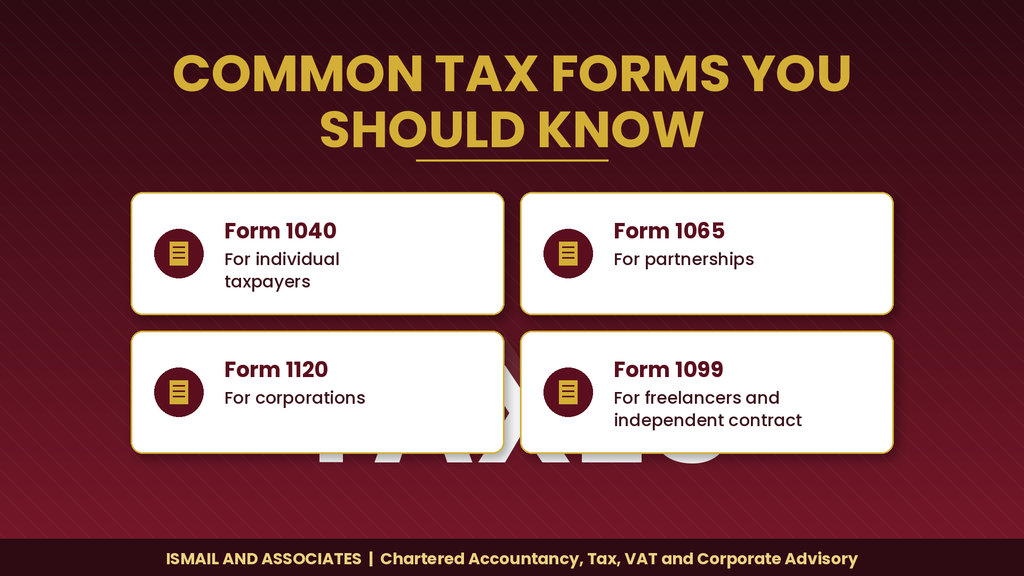
| Form | Common Purpose |
| Form 1040 | Individual federal income tax return |
| Schedule C | Sole proprietor business income/loss |
| Schedule SE | Self-employment tax |
| Form 1040-ES | Estimated tax for individuals |
| Form 1065 | Partnership return |
| Form 1120-S | S corporation return |
| Form 1120 | C corporation income tax return |
| Form 1099-NEC | Certain nonemployee compensation reporting |
| Form 941 | Employer’s quarterly federal payroll tax return |
| Form 940 | Federal unemployment tax return |
7.4 An Eight-Step Filing Process
- Organize business income — Collect all sources of revenue: invoices, credit card payments, bank deposits, online payment platforms, cash receipts, 1099 forms, and marketplace income. Records should reflect the complete picture of business income, not only amounts reported on a 1099.
- Categorize business expenses — Organize costs into consistent categories such as advertising, software, office expenses, professional fees, insurance, rent, utilities, travel, vehicle expenses, contractor payments, payroll, and supplies. Deductibility depends on the applicable tax rules and the facts of each expense.
- Determine the correct business structure — Confirm whether the business operates as a sole proprietorship, partnership, S-corporation, C-corporation, or another classification before choosing the tax return. This step prevents one of the most basic filing errors: using the wrong return type.
- Identify the required IRS forms — Once the entity and tax situation are understood, identify the required federal forms and schedules — for example, Form 1040, Schedule C, and potentially Schedule SE and Form 1040-ES for a sole proprietor.
- Calculate taxable business income — For many businesses, the starting point is revenue minus allowable expenses; depreciation, self-employment tax, credits, basis, and inventory rules can affect the final calculation.
- Identify deductions and credits — Review records for allowable deductions and credits. Accurate bookkeeping supports this step and helps substantiate items reported on the return.
- Handle federal and state tax filing — After the federal return, determine whether state filing obligations apply, based on business location, registration, income, employees, sales, and economic or physical presence.
- Pay the tax and keep records — After calculating the liability, make the required payment and retain supporting records that clearly show income and expenses.
7.5 Deductible Business Expenses
Business owners should distinguish clearly between business and personal expenses. Potentially deductible costs include advertising, supplies, software, professional services, certain travel expenses, and other ordinary business costs, subject to applicable tax rules. Supporting records should show:
- What was purchased
- When it was purchased
- How much was paid
- Who received the payment
- Why the expense was business-related
Supporting documents can include invoices, receipts, paid bills, deposit information, credit card statements, and canceled checks. An expense should never be claimed merely because it appears related to the business — eligibility depends on the applicable rules and facts.
7.6 Estimated Taxes
Many self-employed business owners must make estimated tax payments because their income is not subject to standard employee withholding. Estimated tax can cover both income tax and self-employment tax. For individuals such as sole proprietors, partners, and S-corporation shareholders, estimated payments are generally required when the taxpayer expects to owe $1,000 or more upon filing; corporations generally use a $500 threshold, subject to specific exceptions and calculations. For 2026, estimated tax remains a pay-as-you-go system, and self-employed individuals should plan for it throughout the year rather than only at tax season.
7.7 Federal vs. State Business Taxes
Federal tax is administered primarily through the IRS, while state taxes are administered by individual state tax authorities. Depending on the business and its state, obligations can include state income tax, franchise taxes, sales tax, employer taxes, state information returns, and other state-specific filings. Because rules differ by state, obligations should be assessed based on where the business operates and where it has relevant activity.
7.8 Recordkeeping
At minimum, small business owners should maintain organized records of:
- Business income and sales
- Invoices and receipts
- Business expenses
- Bank and credit card statements
- Contractor payments and payroll
- Business assets, loans, and depreciation information
- Tax forms and previous tax returns
Paper or electronic systems are both acceptable, provided the system clearly shows the necessary business information. Employment tax records should generally be retained for at least four years.
7.9 Common Filing Mistakes
- Mixing personal and business expenses in a single account
- Missing business income that was not reported on a 1099
- Poor recordkeeping, including missing receipts and incomplete transaction records
- Using the wrong tax form for the business’s actual structure
- Ignoring estimated tax obligations where no paycheck withholding applies
- Filing only federal taxes and overlooking state-level obligations
- Waiting until the deadline, which increases the risk of errors and missing information
7.10 When to Hire a Tax Professional
Professional assistance is worth considering when a business:
- Has become more profitable or complex
- Operates as an LLC, partnership, or corporation
- Has employees
- Operates in multiple states
- Receives multiple 1099 forms
- Has significant business deductions or purchased business assets
- Needs estimated tax planning
- Has unfiled or amended returns, or has received an IRS notice
- Simply lacks the time to manage filing directly
Professional preparation is also useful when bookkeeping records need review or cleanup before filing. A professional service can help organize financial information, identify the appropriate forms, prepare returns, review documentation, and manage applicable filing requirements — spanning individual and business returns, Schedule C preparation, 1099-related reporting, partnership and S-corporation returns, federal and state filing, estimated tax support, amendments, and documentation organization.
7.11 Pre-Tax-Season Checklist
- Keep business and personal transactions separate
- Reconcile the business bank account regularly
- Record income as it is received
- Categorize expenses consistently
- Save invoices and receipts
- Track contractor and payroll information
- Review 1099 forms for accuracy
- Monitor estimated tax requirements
- Review bookkeeping before tax season
- Engage a qualified tax professional when the situation becomes complex
8. Frequently Asked Questions
How do I file taxes for my small business?
Start by organizing business income and expenses, identifying your business structure, determining the required IRS forms, calculating taxable income, reviewing deductions and credits, and filing the applicable federal and state returns. A sole proprietor commonly reports business activity using Schedule C with Form 1040.
What tax forms does a small business need?
It depends on the business structure and tax situation. Common forms include Form 1040 and Schedule C for sole proprietors, Form 1065 for partnerships, Form 1120-S for S-corporations, and Form 1120 for C-corporations. Additional forms may apply for estimated taxes, payroll, and information reporting.
Does an LLC need to file a separate tax return?
Not necessarily. An LLC’s federal tax treatment depends on the number of owners and whether it has elected a different tax classification. A single-member LLC is commonly treated as a disregarded entity for federal income tax purposes unless it elects otherwise.
Do small business owners have to pay estimated taxes?
Many self-employed business owners do. Sole proprietors, partners, and S-corporation shareholders may need to make estimated payments if they expect to owe at least $1,000 when filing, subject to applicable rules and exceptions.
What expenses can a small business deduct?
Potential deductions depend on the business and applicable tax rules, and may include advertising, supplies, software, professional services, certain travel costs, and other qualifying business expenses. Deductions claimed should be supported by proper records.
What records should I keep for small business taxes?
Keep records showing business income, expenses, invoices, receipts, bank and credit card activity, payroll information, asset purchases, tax forms, and other documents supporting the return, as these substantiate items reported to the IRS.
Do small businesses have to pay state taxes?
Possibly. State requirements vary based on the business’s activities, location, entity structure, employees, and sales. Filing a federal return does not automatically satisfy every state tax obligation.
What is the difference between Schedule C and Form 1065?
Schedule C is generally used by a sole proprietor to report business income or loss with an individual Form 1040. Form 1065 is generally used by partnerships to report partnership income, deductions, gains, and losses.
When should I hire a tax professional?
Consider professional assistance when a business has employees, multiple owners, operations in multiple states, significant deductions, a complex entity structure, substantial 1099 income, estimated tax obligations, amended returns, or correspondence from the IRS.
Can I outsource my small business tax preparation?
Yes. Many small business owners outsource tax preparation to qualified tax professionals or accounting firms. Before engaging a provider, it is worth verifying their experience with the relevant business structure, tax forms, state requirements, recordkeeping process, and security procedures.
9. Final Takeaway
US tax filing for small business owners is primarily about matching the filing process to the business structure, accurately reporting income and expenses, claiming eligible deductions, meeting estimated tax obligations, and satisfying applicable federal and state requirements.
The best preparation begins well before the filing deadline: keep accurate books, maintain supporting documents, monitor estimated taxes, and review filing requirements each year. Where the process becomes difficult to manage independently, professional tax preparation can reduce administrative burden and support a more efficient, better-organized filing outcome.
RELATED POSTS
View all