



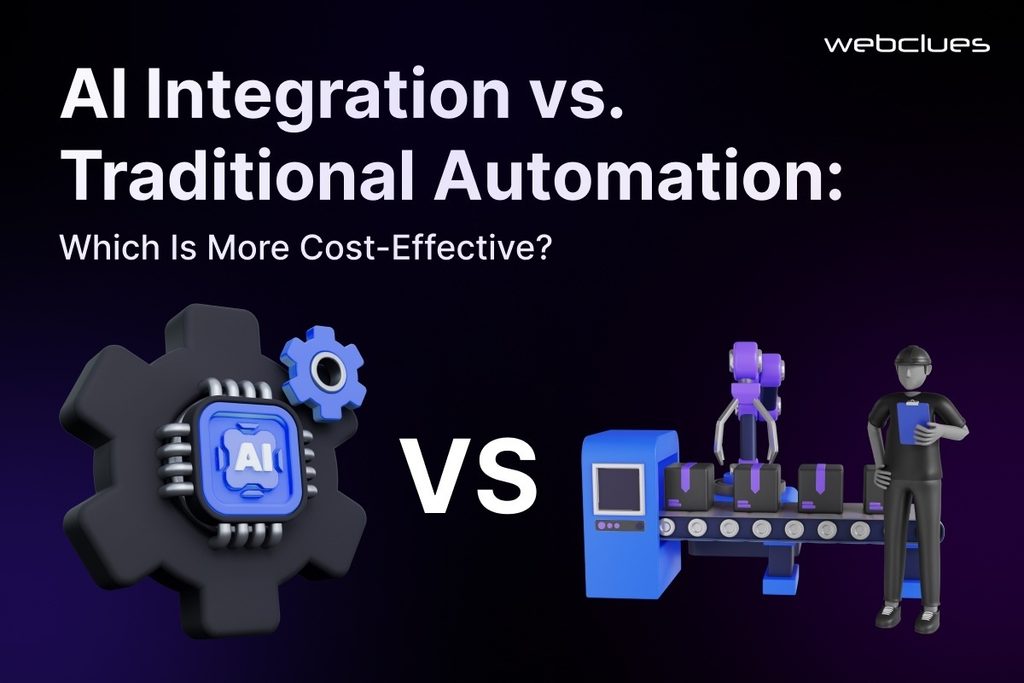
AI INTEGRATION
vs
AI AUTOMATION
Understanding the Difference and Choosing the Right Approach
Prepared by Ismail and Associates
Chartered Accountancy, Tax, VAT, Audit, and Corporate Advisory
Introduction
Artificial intelligence is increasingly discussed as two related but distinct capabilities: AI integration and AI automation. Organizations planning technology investments, workflow redesigns, or process improvements benefit from understanding what each term actually means, how they differ, and how they work together in practice. This document sets out a clear, practical comparison to support informed decision-making.
What Is AI Integration
AI integration refers to embedding artificial intelligence models, tools, or capabilities into existing software, systems, or workflows so that they operate together as one connected environment. The emphasis is on connectivity: linking an AI engine to a company’s databases, applications, or platforms through APIs and data pipelines so that intelligence becomes part of the infrastructure rather than a standalone tool.
- Connects AI capabilities to existing systems, such as an ERP, CRM, or accounting platform
- Enables data to flow between AI models and business applications
- Supports human decision-making by surfacing insights, predictions, or recommendations
- Requires architectural planning: APIs, data formats, security, and system compatibility
What Is AI Automation
AI automation refers to using artificial intelligence to carry out a task or process with minimal or no human involvement. The emphasis is on execution: a defined task is triggered, performed, and completed by the system itself, often on a schedule or in response to an event, without a person needing to act at each step.
- Executes repetitive or rule-based tasks without manual intervention
- Reduces processing time and the risk of manual error
- Can range from simple scripted automation to AI-driven decision automation
- Removes or reduces the need for a human to perform the task directly
Side-by-Side Comparison
| Aspect | AI Integration | AI Automation |
| Definition | Connecting AI models, tools, or data sources into existing systems and workflows so they work together | Using AI to run repetitive tasks or processes with little or no human involvement |
| Primary goal | Enable systems and AI capabilities to communicate and share data seamlessly | Reduce manual effort by having a task performed automatically end-to-end |
| Scope | Architectural: how AI plugs into an ecosystem (software, APIs, databases, platforms) | Operational: what specific task or process gets carried out |
| Human role | Often assists or augments human decision-making within a workflow | Frequently removes or minimizes the need for human action |
| Complexity | Usually more complex; involves APIs, data pipelines, and system architecture | Can range from simple rule-based scripts to more advanced AI-driven processes |
| Typical output | A connected ecosystem where AI insights flow between tools | A completed task or process, executed on a trigger or schedule |
| Example | An AI model embedded in accounting software to flag anomalies as data is entered | An AI bot that automatically reconciles bank statements every night without review |
How They Work Together
AI integration and AI automation are not competing approaches; they are complementary layers. Integration builds the connections that allow AI to access the right data and systems. Automation then uses that connected environment to carry out tasks without manual effort. A well-designed system is typically integrated first, so that data and tools are properly linked, and automated second, so that specific tasks run reliably within that connected structure.
For example, in a finance or accounting context, integration might connect an AI model to a company’s accounting software and bank feeds. Automation would then use that connection to automatically categorize transactions, flag anomalies, or generate reconciliation reports without staff needing to compile the data manually.
Choosing the Right Approach
Consider AI Integration when:
- Multiple systems or data sources need to work together
- The goal is better visibility, insight, or decision support rather than replacing a task
- Human judgment remains central to the final outcome
Consider AI Automation when:
- A task is repetitive, high-volume, or rule-based
- Speed and consistency matter more than case-by-case judgment
- The process is already well-defined and stable
Conclusion
AI integration is about connecting systems so that artificial intelligence becomes part of an organization’s technology environment, while AI automation is about using that intelligence to carry out tasks with minimal human input. Understanding the distinction allows an organization to plan its AI adoption in the right order: build the connections, then automate the tasks that benefit most from it. Used together, they create workflows that are both intelligent and efficient.
ISMAIL AND ASSOCIATES
AI Integration vs. AI Automation
AI Integration
AI is connected to an existing system. AI helps inside the existing workflow.
QuickBooks → AI → Financial Analysis
AI Automation
The system automatically performs a sequence of actions:
| New Invoice Received ↓ AI Reads Invoice ↓ Extracts Data ↓ Checks Supplier ↓ Creates Draft Entry ↓ Sends for Approval ↓ Updates Accounting System ↓ Sends Notification |
| AI Integration | AI Automation |
| Connects AI to software | Automates a workflow |
| AI assists users | AI / system performs the steps |
| Human often initiates the process | Workflow can trigger automatically |
| Focus: connectivity | Focus: execution |
| Example: AI + Excel | Example: Invoice → AI → ERP |
RELATED POSTS
View all