


Company Income Tax Guide in Bangladesh (Finance Act 2026)
July 31, 2026 | by Mohmmed Ismail Miah

A Complete Guide for Companies (Assessment Year 2026–2027)

Company Income Tax Guide in Bangladesh (Finance Act 2026)
A Complete Guide for Companies (Assessment Year 2026–2027)
Introduction of Bangladesh income tax framework
Income Tax Act 2023 (ITA 2023), as amended by the Government from time to time, is the legal framework of imposing income tax in Bangladesh. The Ministry of Finance (MoF) and the National Board of Revenue (NBR), the primary tax regulator, issue statutory orders, general orders, special orders, clarifications, and notifications from time to time to support the tax legislation
Imposition of tax :
Chargeability of tax: Income tax is charged on a taxpayer’s taxable income that is derived in accordance with the provisions of Income Tax Act 2023 during an income year by applying the tax rates prescribed by Finance Acts or Ordinances enacted by the Government of Bangladesh
Residency: In general, a company which is incorporated in Bangladesh will be treated as a resident for tax purposes. Furthermore, any company, trust, fund, an entity or any artificial juridical person created whose control and management are situated wholly in Bangladesh will also be treated as a resident for tax purposes. Any person not being a resident is a non-resident for tax purposes.
Company Income Tax Guide :
Corporate income tax is one of the most important direct taxes in Bangladesh. Every company operating in Bangladesh must comply with the provisions of the Income Tax Act, 2023 (as amended by the Finance Act, 2026). Proper tax planning and timely compliance help businesses avoid penalties while improving financial transparency.
What is Company Income Tax?
Company Income Tax is the tax imposed on the taxable profits earned by a company during an income year.
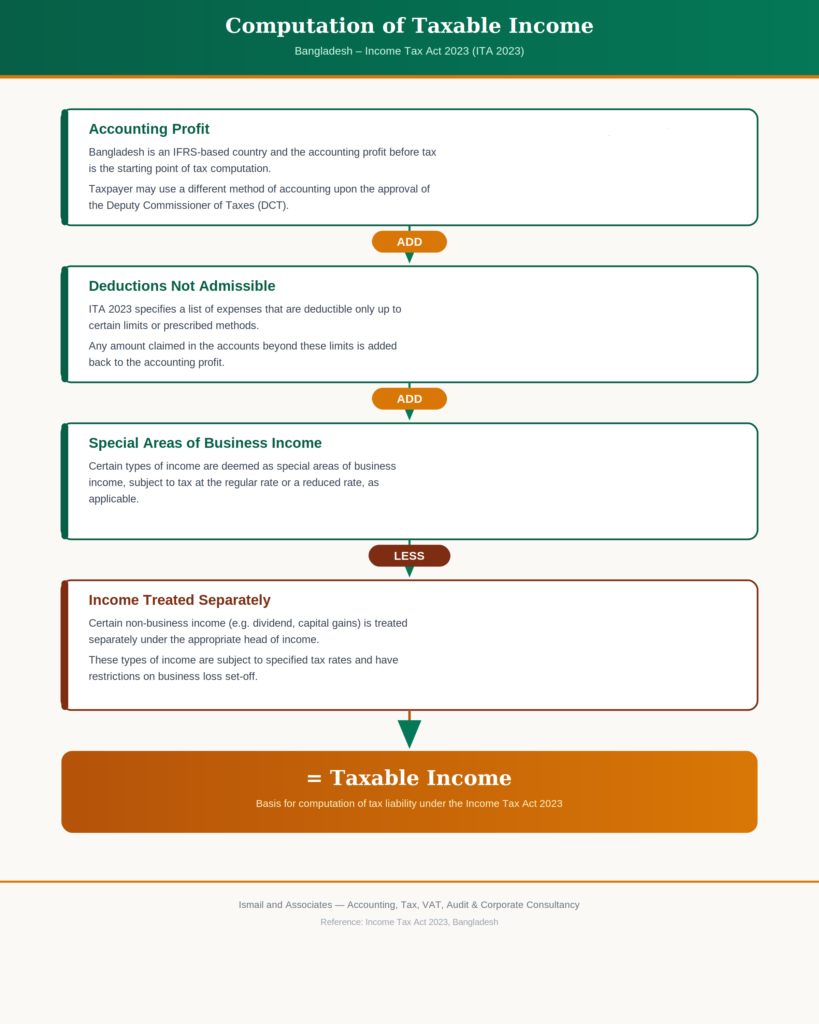
Computation of taxable income :Income Tax Act 2023 provides a general guidance on computing taxable income to determine tax liability for an income year.
Taxable income :
Accounting profit : Bangladesh is an IFRS based country and the accounting profit before tax is the starting point of tax computation.Taxpayer may use different method of accounting upon the approval of the Deputy Commissioner of Tax.
Add: Deductions not admissible :ITA 2023 also specifies a list of expenses which are deductible up to certain limits or prescribed methods.
Add: Special areas of business income :Certain types of income are deemed as special areas of business income subject to tax at regular rate or reduced rate, as the case maybe.
Less : Income treated separately : Certain non-business income (e.g. dividend, capital gains) is treated separately under appropriate head of income. These types of income are subject to specified tax rates and have restrictions on business loss set-off.
Set-off and carry forward rules :
Set-off: Any loss from a head of income during an income year can be set off against income from other heads of income, unless it is restricted. Any losses that cannot be fully set-off can be carried forward for a maximum of six successive years. Loss set-off is highly restrictive. Carried forward loss is to be adjusted before adjusting for any depreciation allowance for a specified income year and unabsorbed depreciation from prior income years.
Carry-forward :
| Heads of income | Adjustment of loss |
| Capital loss | Only with capital gain |
| Business loss | Only with the income from business |
| Loss from speculation business | Only with income from speculation business |
| Loss on tobacco business | Only with income from tobacco business |
| Loss from sources of income which is subject to tax exemption, reduced tax rate or final tax | No set-off and carried forward of loss |
| Amalgamation and demerger | Accumulated business loss and unabsorbed depreciation of amalgamating or demerged company can be used by amalgamated company and resulting company, respectively. |
Types of tax
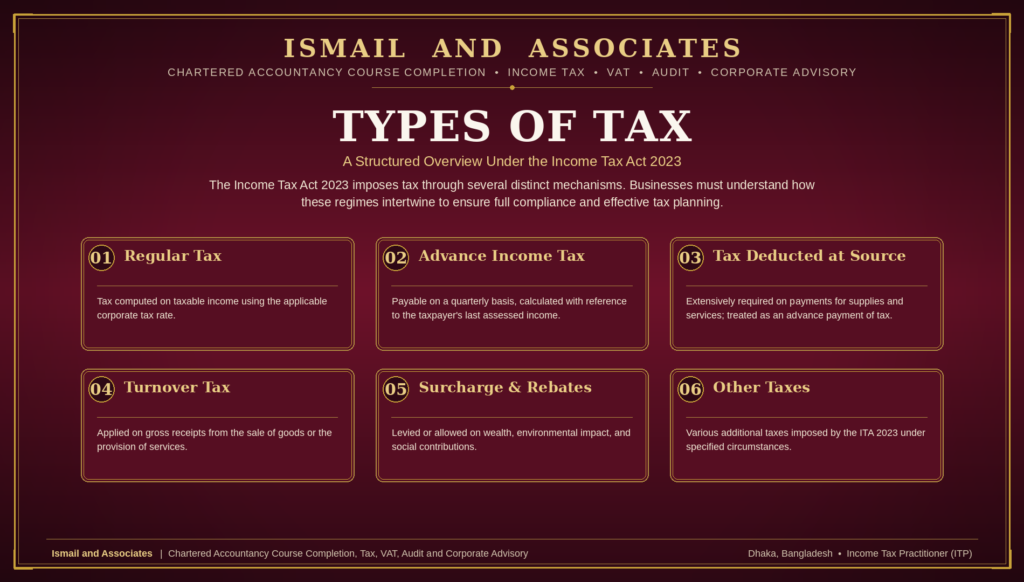
Income Tax Act 2023 imposes tax through various mechanisms. Businesses need to be aware of the complex intertwining of tax regimes to ensure both tax compliance and effective tax planning.
1. Regular tax: Tax as computed based on taxable income using the applicable corporate tax rate.
2. Advance income tax: Taxpayers are required to pay advance income tax on a quarterly basis as per their last assessed income.
3. Tax deducted at source: ITA 2023 extensively requires tax to be deducted on payment for supplies and services. Such tax deductions are considered as advance payments of tax
4. Turnover tax: Turnover tax provisions apply on the basis of gross receipts from sale of goods or providing any services.
5. Surcharge and rebates: ITA 2023 also imposes surcharges and rebates on wealth, environmental impact, and social contributions.
6. Other taxes: ITA 2023 imposes various additional taxes under certain circumstances
Types of tax returns
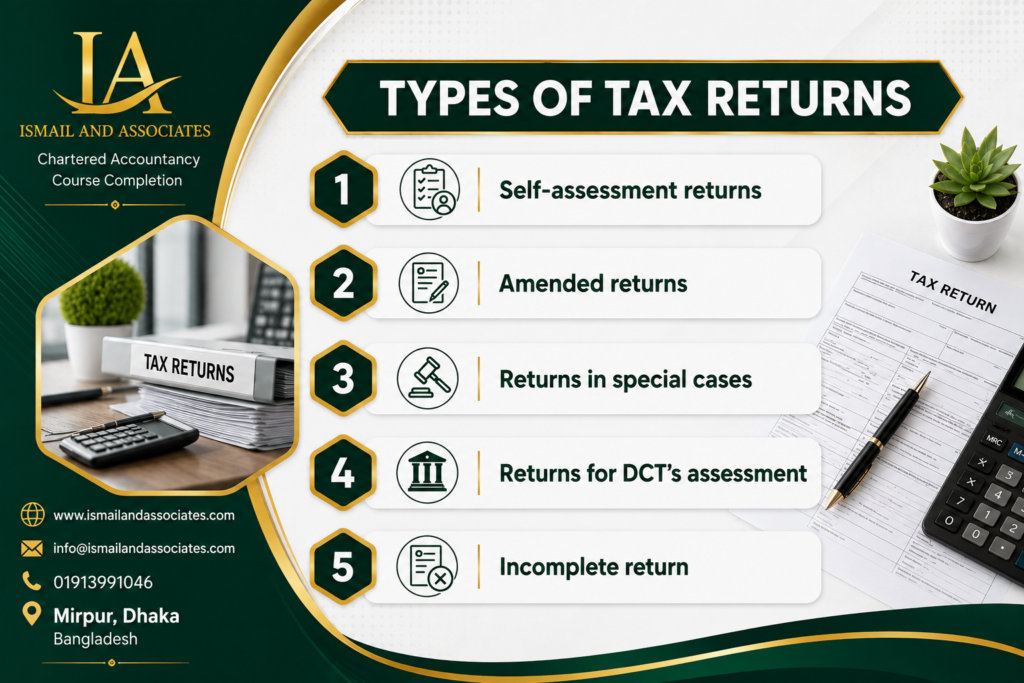
1. Self-assessment returns
2. Amended returns
3. Returns in special cases
4. Returns for DCT’s assessment
5. Incomplete return
Key tax obligations at a glance
- Tax registrations (TIN)
- Withholding Identification Number (WIN)
- Proof of submission of return (PSR)
- Comply with withholding tax and advance income tax requirements
Preparing for submission of tax return
- Audited Financial Statements
- Computation of income and tax payment
- Prepare Statement of International Transactions (TP Return)
- Prepare submission dec
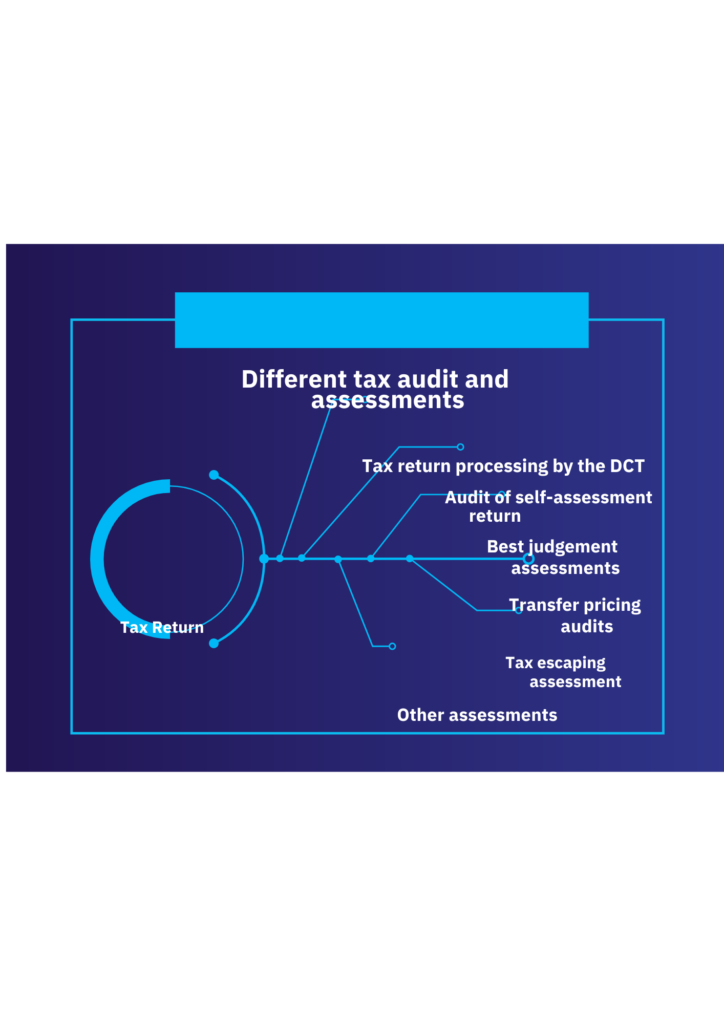
Tax assessments
| Tenure of completion of assessment | |
| Return processing | within 12 months of return submission |
| Return processing for instances of refund of individuals | within 4 months of selection of audit |
| Self-assessment return | within 12 months of return submission |
| Assessment by the DCT upon hearing | within 12 months of return submission |
| Income escaping assessment | within 12 months of notice |
| TP returns | within 5 years of assessment year |
| Set aside assessment orders | within 90 days of communication to the DCT |
| Revised orders | within 45 days of communication to DCT |
Appeal stages
- First Appeal: Within 45 days from the date of receiving of assessment order, the first appeal is to be filed before the Commissioner of Taxes (Appeal).To be disposed of within 150 days from the month of filing of appeal.Taxpayer pays 1% of disputed tax before filing first appeal.
- Second Appeal: If aggrieved against the first appeal order, the second appeal is to be filed within 60 days from the date of receiving of first appeal order to the Taxes Appellate TribunalTo be disposed of within 180 days from the month of filing of appeal.Taxpayer pays 3% of disputed tax before filing second appeal.
A taxpayer has the opportunity for submitting an application for rectification of error where the appellate authority or tribunal has not provided a reasonable opportunity to show cause, and the appeal order fails to specify the issues for determination, the decision taken, and the reasons supporting that decision.
High Court
Aggrieved taxpayer can further apply to
- High Court : Reference application to the High Court Division of the Supreme Court can be filed within 90 days from the date of receiving Tribunal order, but only in the areas of law and not for reducing the disputed tax. Applicant must pay 10% of disputed tax. No opportunity to submit application for reducing disputed tax
- Appellate Division :No time limit for disposal of appeal to the Appellate Division is mentioned in the tax law
Alternative Dispute Resolution (ADR)
A taxpayer may choose ADR route if the case is disputed with any appellate authorities and an appeal filed by the DCT at Tribunal or reference application made by the Commissioner of Taxes (Appeals) at High Court, will be stayed until disposal of the ADR application. However, any dispute which has already been filed in the form of a writ petition will not be subject of ADR. A taxpayer would not be eligible for application to ADR if they fail to pay admitted tax liability, where the return of income for relevant year or years has been submitted. In cases of disputed legal interpretation, the opinion of NBR may be sought to ensure alignment with regulatory intent. ADR settlement record must comprehensively capture the agreed terms, including the nature of the settlement, tax payable or refundable, payment timeline and method. The maximum payment period is capped at 6 months in case of settlement. In case of ADR, time limit for the facilitator to make an agreement is 3 months from the end of the month in which the application was made, unless no agreement is deemed to have been reached. Taxpayer needs to comply with Income Tax Alternative Dispute Resolution Rule 2024
International tax
Tax treaties : Double Tax Avoidance Agreements (DTAAs) are agreements between Bangladesh and contracted country aiming to avoid double taxation by defining the taxing rights of each country concerning cross-border flows of income.
Foreign entities doing business in Banglades
Permanent establishments : Foreign or non-resident enterprises constitute a permanent establishment in Bangladesh if they generate business income through a fixed place or place of business from which its business operations are wholly or partly carried on. This includes: • any place of management; • any branch; • any agency; • any office; • any warehouse • any factory; • any workshop; • any mine, oil or gas well, quarry or any other place for exploration, extraction or extraction of natural resources;
any farm or plantation; • any construction site, any construction, installation or addition project or any supervisory activity related thereto; • furnishing of services either by itself or through any manpower engaged for such purpose, if such activities continue in Bangladesh (in the same work or in any other work connected with the said work); Transaction with non-residents • any associated entity or any person commercially dependent on the non-resident person who carries on any activity connected with any sale made by the non-resident person in Bangladesh; • digital or online platforms having 100,000 Bangladeshi subscribers
Digital services : Transactions initiated online are now classified as electronic sales, irrespective of payment or delivery mode
Withholding taxes : Specific withholding taxes apply for non-residents. Withholding taxes are deducted against on non-resident unilaterally unless an exemption applies. Withholding tax is considered final tax for non residents having no permanent establishments in Bangladesh
Transaction with non-residents : DCT can determine a reasonable amount to be included in a resident’s total income for tax purposes if it is found that the resident has entered into a transaction with a non-resident and due to their close relationship, the transaction
Transfer of assets to non-residen : If tax is evaded by way of transfer of any asset or any reason thereof, whether jointly or severally with associated enterprises, tax would be recovered from the person who acquires the right to enjoy that income or receives money related to the transaction.
Transfer pricing regulations : Transactions considered under transfer pricing regulation are those transactions between associated enterprises, either or both of whom are non-residents, relating to transfer of tangible or intangible goods, provision of services or any other transactions that have a bearing on the profits, income, losses, assets, financial position or economic value of such enterprises, etc.
Arm‘s length pricing : “Arm’s length price” means a transaction price the terms of which (such as price, margin or profit sharing) do not differ from those prevailing in a comparable uncontrolled transaction between two independent parties under comparable situations

Who Must Pay Company Income Tax?
The following entities are generally required to pay corporate income tax:
- Private Limited Company
- Public Limited Company
- One Person Company (OPC)
- Foreign Company
- Branch Office
- Liaison Office (where taxable)
- Banking Company
- Insurance Company
- Financial Institution
- Mobile Telecommunication Company
- Manufacturing Company
- Export-Oriented Company
Governing Laws
Corporate income tax in Bangladesh is governed by:
- Income Tax Act, 2023
- Finance Act, 2026
- Income Tax Rules
- National Board of Revenue (NBR) Circulars and Notifications
Sources of Company Income
Corporate taxable income generally includes:
- Business income
- Trading profit
- Manufacturing profit
- Service income
- Rental income
- Interest income
- Dividend income (subject to applicable provisions)
- Capital gains
- Foreign-source income (where applicable)
Allowable Business Expenses
A company may deduct ordinary and necessary business expenses, including:
- Employee salaries and wages
- Rent and utilities
- Office expenses
- Marketing and advertising
- Depreciation (as per tax law)
- Vehicle expenses
- Repair and maintenance
- Audit fees
- Professional fees
- Bank charges
- Insurance expenses
- Research and development expenses (where applicable)
Non-Allowable Expenses
Examples of expenses that are generally not deductible include:
- Personal expenses
- Income tax paid
- Penalties and fines
- Illegal payments
- Excessive entertainment expenses (subject to law)
- Unsupported cash expenses
- Non-business expenses
Tax Depreciation
Depreciation is allowed on eligible fixed assets according to the rates prescribed under the Income Tax Act and relevant rules.
Common asset categories include:
- Buildings
- Plant and machinery
- Furniture
- Office equipment
- Computers
- Vehicles
Advance Income Tax (AIT)
Companies may be required to pay Advance Income Tax through:
- Import stage
- Export stage
- TDS (Tax Deducted at Source)
- VDS (where applicable)
- Other statutory deductions
These payments are generally adjustable against the final income tax liability, subject to applicable provisions.
Tax Deducted at Source (TDS)
Companies are often responsible for deducting tax at source on specified payments, including:
- Salary
- Contractor payments
- Professional services
- Rent
- Commission
- Interest
- Freight
- Royalties
The deducted tax must be deposited with the government within the prescribed time.
Corporate Tax Compliance Checklist
Every company should:
- Maintain proper books of accounts
- Prepare annual financial statements
- Obtain statutory audit (where required)
- Calculate taxable income correctly
- Submit the income tax return within the due date
- Pay taxes on time
- Preserve supporting documents
- Maintain TDS records
- Reconcile tax payments with NBR records
Required Documents
Common documents include:
- Audited Financial Statements
- Trial Balance
- General Ledger
- Bank Statements
- Fixed Asset Register
- VAT Returns
- TDS Certificates
- Import & Export Documents
- Loan Statements
- Investment Schedule
Benefits of Proper Tax Compliance
Timely compliance offers several advantages:
- Avoidance of penalties and interest
- Improved corporate governance
- Better creditworthiness
- Easier access to bank financing
- Increased investor confidence
- Reduced tax disputes
- Stronger business reputation
Common Mistakes Companies Should Avoid
- Late filing of tax returns
- Incorrect expense claims
- Poor bookkeeping
- Failure to deduct TDS
- Inadequate supporting documentation
- Ignoring tax notices
- Errors in depreciation calculations
- Failure to reconcile accounting profit with taxable income
Best Practices
To ensure effective corporate tax management:
- Maintain accurate accounting records.
- Perform monthly tax reconciliations.
- Review tax compliance periodically.
- Keep documentation organized.
- Monitor amendments to tax laws.
- Seek professional advice for complex transactions.
Frequently Asked Questions (FAQs)
1. Is every company required to file an income tax return?
Yes. Companies are generally required to submit an annual income tax return in accordance with applicable tax laws.
2. Can business expenses reduce taxable income?
Yes. Allowable business expenses incurred wholly and exclusively for business purposes may generally be deducted, subject to the Income Tax Act.
3. Are companies required to deduct TDS?
Yes. Companies making specified payments are generally required to deduct and deposit Tax Deducted at Source (TDS) as prescribed by law.
4. What happens if a company files its return late?
Late filing may result in penalties, interest, and other legal consequences under the applicable provisions.
Conclusion
Corporate income tax compliance is a critical responsibility for every business in Bangladesh. By maintaining accurate accounting records, understanding allowable deductions, meeting filing deadlines, and complying with the Income Tax Act, 2023 (as amended by the Finance Act, 2026), companies can minimize tax risks and operate with greater financial confidence.
Prepared by:
Ismail and Associates
Professional Tax, VAT, Accounting, Audit & Corporate Consultancy Services
RELATED POSTS
View all