



AI AUTOMATION
A Practical Guide for Modern Accounting, Tax, VAT and Advisory Services
Website Content Document
AI Automation — Detailed Explanation
AI Automation means using Artificial Intelligence (AI), workflow automation, and business software to perform repetitive or decision-support tasks automatically, with minimal human intervention.
For the Ismail and Associates professional service business, AI Automation can become a major part of Accounts, Tax, VAT, Compliance, and Business Advisory services.
1. AI Automation vs. Traditional Automation
| Feature | Traditional Automation | AI Automation |
| Basic principle | Rule-based | AI and rules |
| Decision-making | Fixed rules | Can interpret information |
| Unstructured documents | Limited | Can read and understand |
| Emails | Template-based | Can understand and draft replies |
| Invoices | Fixed data fields | Can extract invoice information |
| Reports | Predefined | Can analyze and summarize |
| Human involvement | Often required | Reduced |
| Example | If payment received, send SMS | Understand payment email, classify, update records, notify |
Simple Example
Traditional:
- If an invoice is overdue, send a reminder.
AI Automation:
- AI reads the customer or account status, identifies overdue invoices, determines the appropriate reminder, drafts a personalized message, sends it through the approved workflow, and records the action.
2. Main Components of AI Automation
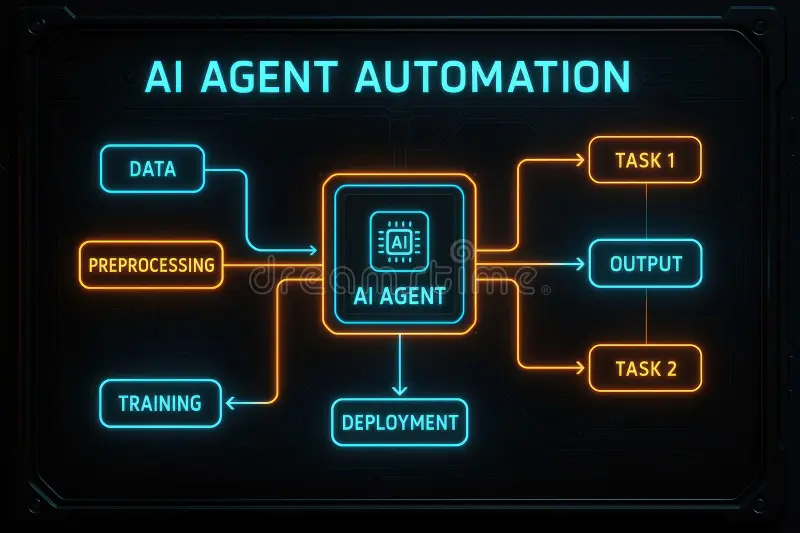
A professional AI automation system generally has five layers:
① Data
Information comes from:
- Emails
- Excel files
- PDFs
- Invoices
- Bank statements
- Accounting software
- CRM
- Website forms
- Documents
- Customer messages
② AI
AI interprets the information. Examples:
- Document understanding
- Text classification
- Data extraction
- Summarization
- Question answering
- Forecasting
- Anomaly detection
③ Workflow Automation
Tools connect the systems and execute actions. Examples:
- Zapier
- Make
- n8n
- Microsoft Power Automate
④ Business Applications
AI automation can connect with:
- QuickBooks Online
- Xero
- Zoho Books
- Microsoft Excel
- Google Sheets
- Gmail/Outlook
- CRM systems
- WordPress
- Cloud storage
⑤ Human Approval
For important financial, tax, and compliance matters, the workflow should normally include:
AI → Review → Human Approval → Final Action
This is especially important for professional advisory work.
3. AI Automation Workflow
A typical workflow looks like this:
INPUT → AI PROCESSING → DECISION → AUTOMATION → HUMAN REVIEW → OUTPUT → RECORD
Example
→ Client sends invoice by email
→ AI detects invoice
→ Extracts: supplier, invoice number, date, amount, VAT, tax, due date
→ Checks required information
→ Creates accounting entry/draft
→ Flags unusual information
→ Accountant reviews
→ Approved transaction is posted
→ Client receives confirmation
→ Audit trail is maintained
4. AI Automation for Accounting
This is one of the strongest opportunities for professional services.
Invoice Processing
→ Email/PDF invoice
→ AI extracts data
→ Validates information
→ Classifies expense
→ Creates draft transaction
→ Accountant approval
→ Accounting system
Bank Reconciliation
→ Bank statement
→ AI identifies transactions
→ Matches invoices/payments
→ Finds unmatched transactions
→ Creates reconciliation report
Expense Management
→ Receipt
→ OCR/AI extraction
→ Expense classification
→ Tax/VAT identification
→ Accounting entry
→ Approval
5. AI Automation for Tax Services
AI can assist with:
- Tax document collection
- Document classification
- Data extraction
- Tax information summaries
- Missing-document identification
- Tax return preparation support
- Deadline reminders
- Client communication
- Tax research assistance
- Compliance checklists
Example
→ Client uploads documents
→ AI categorizes: salary, bank interest, business income, investment, property, expenses
→ Creates a tax information checklist
→ Identifies missing information
→ Professional reviews
→ Final tax work is completed
Important: AI should support professional judgment, not independently make final tax or compliance decisions.
6. AI Automation for VAT
For VAT-related services, automation can help with:
- VAT invoice extraction
- Purchase/sales classification
- VAT calculation checks
- VAT document organization
- VAT return preparation support
- Missing-document detection
- VAT reconciliation
- Compliance reminders
Example
→ Sales invoices
→ AI extracts VAT information
→ Categorizes transactions
→ Compares accounting records
→ Identifies discrepancies
→ Creates VAT reconciliation report
→ Professional review
7. AI Automation for Compliance
A compliance automation system can maintain a calendar for:
- Tax return deadlines
- VAT returns
- Trade licence renewal
- Corporate filings
- Payroll requirements
- Bank documentation
- Regulatory submissions
- Client document expiry
Example
- 30 days before deadline: automatic reminder
- 15 days before deadline: second reminder
- 7 days before deadline: urgent reminder
- After completion: update compliance status
8. AI Email Automation
AI can help manage large numbers of business emails.
Workflow
→ Incoming email
→ AI reads the message
→ Classifies: tax, VAT, accounts, bank, client inquiry, document request, payment, urgent matter
→ Assigns priority
→ Creates summary
→ Drafts response
→ Human reviews
→ Email is sent
This can save significant administrative time.
9. AI Document Automation
A professional firm receives many documents. AI can automatically process:
- Excel
- Word
- Scanned documents
- Invoices
- Bank statements
- Contracts
- Tax documents
- Receipts
Example
For a 100-page financial document, AI can:
- Read the document
- Extract relevant information
- Identify important sections
- Summarize it
- Create a checklist
- Identify inconsistencies
- Prepare a review report
10. AI Financial Reporting Automation
Monthly Workflow
→ Accounting data
→ AI analysis
→ Financial statements
→ Management report
→ KPI analysis
→ Variance analysis
→ Management dashboard
→ Management receives report
AI can help explain:
- Revenue increased by X%
- Administrative expenses increased
- Receivables are rising
- Cash flow requires attention
- Gross margin changed
Financial conclusions should always be reviewed by the responsible professional.
11. AI Automation for Management Reporting
A Professional Automated Report Can Include
Financial KPIs:
- Sales
- Gross profit
- Net profit
- EBITDA
- Working capital
- Receivables
- Payables
- Inventory
- Cash balance
- Debt
- Cash conversion
Management analysis:
- Actual vs Budget
- Current Month vs Previous Month
- Current Year vs Previous Year
- Variance Analysis
- Trend Analysis
12. AI Automation for Client Onboarding
A website can collect client information through a form.
Workflow
→ Client visits website
→ Completes onboarding form
→ AI analyzes requirements
→ Classifies client (individual tax client, business accounting client, VAT client, corporate client, international tax client)
→ CRM record created
→ Welcome email drafted
→ Document checklist generated
→ Task assigned
13. AI Chatbot for the Website
The website can have an AI assistant that answers general questions such as:
- What accounting services do you provide?
- What is VAT?
- What documents are required for tax services?
- How can I contact Ismail and Associates?
- What is a Trade Licence?
- What accounting software do you support?
The chatbot can also collect basic enquiry information and send it to the team. For tax and legal matters, it should clearly distinguish general information from professional advice.
14. AI Automation for Lead Generation
→ Website visitor
→ AI chatbot/form
→ Collects enquiry
→ AI identifies service requirement
→ Lead score
→ CRM
→ Automatic follow-up
→ Appointment request
→ Professional consultation
This creates a 24/7 lead-management system.
15. AI Automation for the Website
For ismailandassociates.com, a possible architecture is:
→ Website
→ AI Assistant
→ Lead Capture
→ CRM
→ Email Automation
→ Document Collection
→ Accounting/Tax Workflow
→ Professional Review
→ Client Delivery
This can turn the website from a simple information site into a digital professional-service platform.
16. Recommended AI Automation Technology Stack
| Purpose | Possible Technology |
| AI | OpenAI |
| Workflow | n8n / Make / Zapier |
| Accounting | QuickBooks / Xero / Zoho Books |
| Documents | Google Drive / OneDrive |
| Spreadsheet | Excel / Google Sheets |
| Gmail / Outlook | |
| CRM | HubSpot or similar |
| Website | WordPress |
| Forms | WordPress form system |
| OCR | AI/OCR service |
| Dashboard | Power BI |
| Database | Airtable / database |
| Notifications | Email / Teams / Slack |
A full stack is not required initially.
17. Best AI Automation Roadmap for Ismail and Associates
Phase 1 — Foundation
Website, professional email, and cloud storage.
Phase 2 — Lead Automation
Website form → CRM → automatic acknowledgement → lead notification.
Phase 3 — Document Automation
Client document upload → AI document classification → data extraction → checklist.
Phase 4 — Accounting Automation
Invoice → AI extraction → accounting system → review.
Phase 5 — Tax/VAT Automation
Client data → AI organization → tax/VAT checklist → professional review.
Phase 6 — Management Dashboard
Accounting data → AI analysis → dashboard → management report.
Phase 7 — Advanced AI Agent
Client request → AI understands requirement → finds relevant information → creates draft work → requests approval → human approves → system completes workflow.
18. AI Automation Business Model
Potential client-facing service tiers:
| Tier | Service |
| Basic | AI-Assisted Accounting |
| Professional | AI Accounting and Compliance Automation |
| Advanced | AI Finance Automation |
| Enterprise | AI-Powered Finance and Business Advisory |
This fits well with a longer-term goal of positioning Ismail and Associates as an AI-enabled Finance and Accounting Consultant.
19. Most Important Principle
For professional accounting, tax, and VAT services, the recommended model is:
- AI does the repetitive work.
- Automation moves the information.
- Software records the transaction.
- The professional makes the final decision.
This gives the benefits of AI while maintaining accuracy, confidentiality, accountability, and professional control.
One-line Definition for the Website
AI Automation combines artificial intelligence with automated workflows and business software to reduce repetitive work, improve efficiency, accelerate decision-making, and deliver smarter professional services.
RELATED POSTS
View all


A Complete Guide US Tax Filling for Individuals and Small Businesses
September 16, 2026 | by Mohmmed Ismail Miah
Export Performance Report From 1st July-2021 to 30 June-2026
July 28, 2026 | by Mohmmed Ismail Miah