




UNDERSTAND BASIC ACCOUNTING TERMS
1. Recording and Organising Transactions
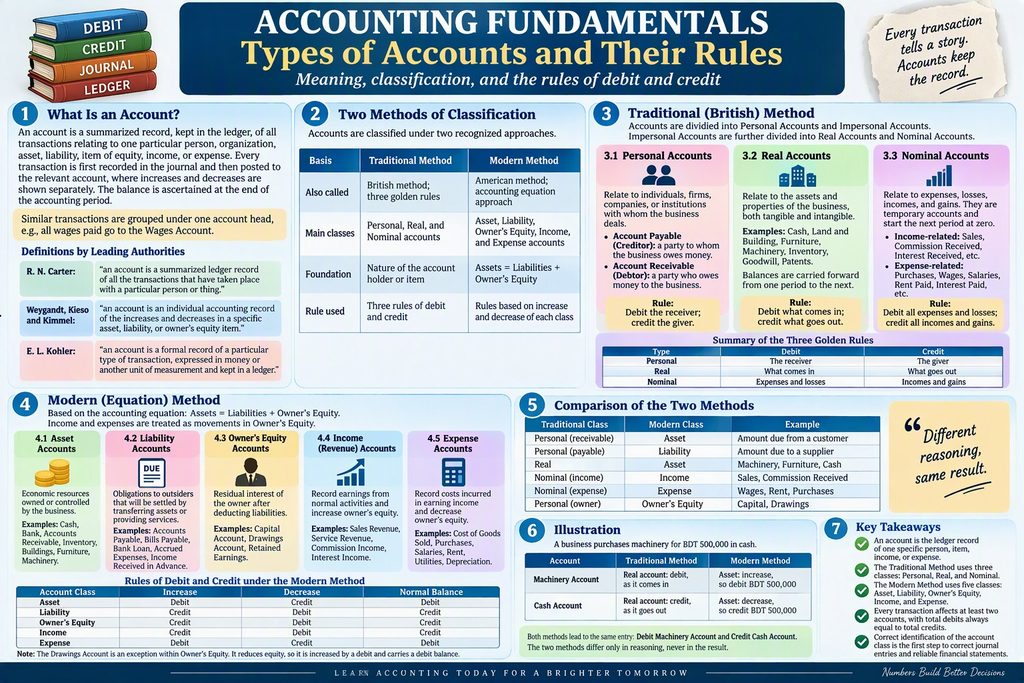
Chart of Accounts (COA): An organised list of all financial accounts used in a company’s general ledger. It classifies transactions into categories such as Assets, Liabilities, Equity, Income and Expenses.
Debit: An accounting entry recorded on the left side of an account. Generally, a debit increases assets and expenses and decreases liabilities, equity and income.
Credit: An accounting entry recorded on the right side of an account. Generally, a credit increases liabilities, equity and income and decreases assets and expenses.
Trial Balance: A statement listing the balances of all ledger accounts in debit and credit columns. It is prepared to check the arithmetical accuracy of the bookkeeping records.
Key Rule: Total Debits = Total Credits
2. The Building Blocks of the Balance Sheet
Accounts Receivable: Accounts receivable (AR) is the balance of money due to a firm for goods or services delivered but not yet paid for by customers. It is reported on the balance sheet as a current asset.
Accounts Payable: Accounts payable (AP) is an account within the general ledger that represents a company’s obligation to pay short-term debts to its creditors or suppliers. It is reported on the balance sheet as a current liability.
Assets: An asset is a resource with economic value that an individual, corporation or country owns or controls with the expectation that it will provide a future benefit. Assets are reported on the balance sheet.
- Current Assets: Assets expected to be sold, consumed, used or converted into cash within one year, or within the normal operating cycle. Examples include cash, receivables and inventory.
- Fixed Assets: Long-term tangible property or equipment that a firm owns and uses in its operations to generate income. They usually appear on the balance sheet as property, plant and equipment (PPE) and are also called capital assets.
Liability: A liability is an obligation, something owed to somebody. Liabilities are a company’s legal financial debts or obligations that arise in the course of business operations.
- Current Liabilities: Short-term financial obligations due within one year or within a normal operating cycle.
- Long-Term Liabilities: Obligations due more than one year in the future, also called long-term debt or non-current liabilities.
Equity: Usually referred to as shareholders’ equity. It represents the residual interest in the assets after deducting liabilities (Assets – Liabilities), i.e. the amount that would be returned to shareholders.
3. Earning and Spending
Revenue: Income generated from normal business operations. It is the top line, or gross income figure, from which costs are subtracted to arrive at net income.
Expense: The cost of operations that a company incurs to generate revenue. As the saying goes, it costs money to make money.
Cost of Goods Sold: The direct expenses of producing the goods sold by a business. The exact calculation depends on what is produced, but it typically includes the cost of raw materials and the direct labour used in production.
Net Income: A company’s total earnings, also called net profit. It is calculated by subtracting total expenses from total revenues.
Return on Investment: A measure of financial performance relative to the money invested. ROI is calculated by dividing net profit by the cost of the investment and is usually expressed as a percentage.
4. The Financial Statements
Businesses report their results through a set of connected statements.
Balance Sheet: A financial statement that reports a company’s assets, liabilities and shareholders’ equity at a specific point in time.
Income Statement: One of the three main financial statements, reporting financial performance over a specific accounting period. Also known as the profit and loss statement or the statement of revenue and expense, it focuses on revenues and expenses during the period.
Cash Flow Statement: A financial statement showing all cash inflows from ongoing operations and external investment sources, and all cash outflows for business activities and investments during a given period.
Retained Earnings Statement: A statement outlining changes in retained earnings over a period. It reconciles opening and closing retained earnings using net income from the income statement, and helps analysts understand how profits are used.
5. Accounting Methods and Standards
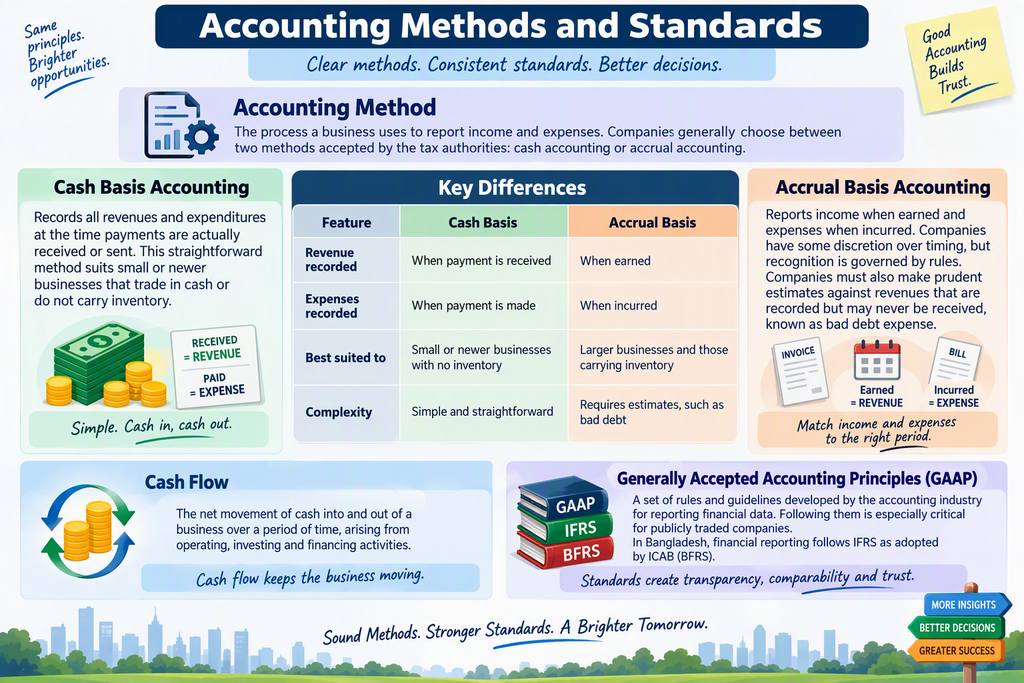
Accounting Method: The process a business uses to report income and expenses. Companies generally choose between two methods accepted by the tax authorities: cash accounting or accrual accounting.
| Feature | Cash Basis | Accrual Basis |
| Revenue recorded | When payment is received | When earned |
| Expenses recorded | When payment is made | When incurred |
| Best suited to | Small or newer businesses with no inventory | Larger businesses and those carrying inventory |
| Complexity | Simple and straightforward | Requires estimates, such as bad debt |
Cash Basis Accounting: Records all revenues and expenditures at the time payments are actually received or sent. This straightforward method suits small or newer businesses that trade in cash or do not carry inventory.
Accrual Basis Accounting: Reports income when earned and expenses when incurred. Companies have some discretion over timing, but recognition is governed by rules. Companies must also make prudent estimates against revenues that are recorded but may never be received, known as bad debt expense.
Cash Flow: The net movement of cash into and out of a business over a period of time, arising from operating, investing and financing activities.
Generally Accepted Accounting Principles (GAAP): A set of rules and guidelines developed by the accounting industry for reporting financial data. Following them is especially critical for publicly traded companies. In Bangladesh, financial reporting follows IFRS as adopted by ICAB (BFRS).
6. Business Structure, Risk and Investment
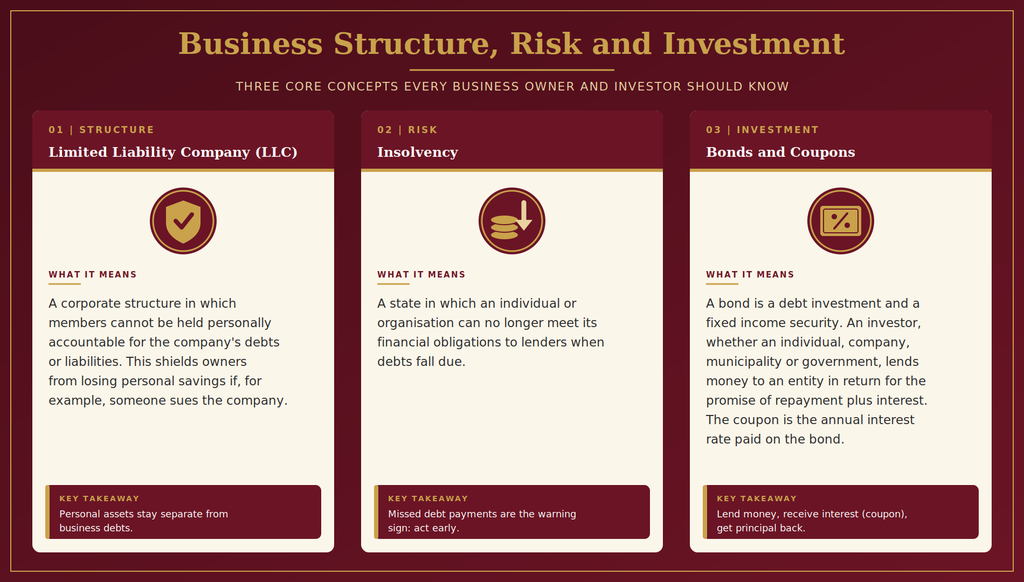
Limited Liability Company (LLC): A corporate structure in which members cannot be held personally accountable for the company’s debts or liabilities. This shields owners from losing personal savings if, for example, someone sues the company.
Insolvency: A state in which an individual or organisation can no longer meet its financial obligations to lenders when debts fall due.
Bonds and Coupons: A bond is a debt investment and a fixed income security. An investor, whether an individual, company, municipality or government, lends money to an entity in return for the promise of repayment plus interest. The coupon is the annual interest rate paid on the bond.
Quick Reference: Key Formulas
| Measure | Formula |
| Accounting equation | Assets = Liabilities + Equity |
| Net income | Total revenues – Total expenses |
| Return on investment (ROI) | (Net profit / Cost of investment) x 100 |
| Closing retained earnings | Opening retained earnings + Net income – Dividends |
RELATED POSTS
View all