


Complete Guide to VAT Return in Bangladesh (Finance Act 2026)
August 1, 2026 | by Mohmmed Ismail Miah

Value Added Tax and Supplementary Duty Act 2012
Complete Guide to VAT Return in Bangladesh (Finance Act 2026)
The content includes significant provisions from the Income Tax Act 2023, the Value Added Tax and Supplementary Duty Act 2012, as amended by the Finance Act 2026.
VAT and Supplementary Duty are imposed on activities carried on regularly or continuously for making supply of any goods, services or immovable property. However, services rendered by an employee to his employer, general duties rendered by a director of a company, any recreational pursuit or hobby performed on a non-commercial basis, and any activities carried on by the Government without any commercial motive are excluded from the definition of economic activities
Key changes of Finance Act 2026
Extended VAT return filing: Businesses must file VAT returns within 15 days from the end a three-month or quarterly cycle from previously monthly filing.
Proof of VAT registration: VAT legislation has begun to require proof of VAT registration for obtaining certain services.
VAT invoice digitization: VAT Invoice or Mushak 6.3 can be issued through the registered entity’s ERP system. Preservation of electronic VAT Invoice or Mushak 6.3 is allowed. In case of mobile financial services, online notifications or statements can be treated as VAT Invoice or Mushak 6.3
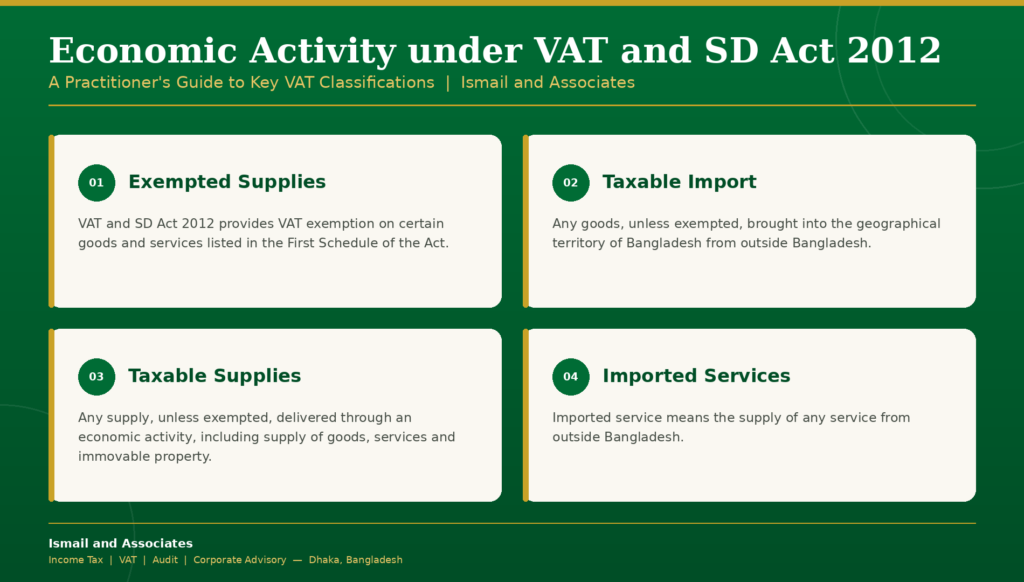
Economic Activity :
Exempted Supplies : VAT & SD Act 2012 provides VAT exemption on certain goods and services in the First Schedule of the Act.
Taxable Import : Any goods, unless exempted, brought into the geographical territory of Bangladesh from outside Bangladesh
Taxable Supplies ; Any supply, unless exempted, delivered through an economic activity which includes supply of goods, services and immovable property.
Imported Services : Imported service means supply of any service from outside Bangladesh.
Place of supply: Destination of supply is crucial for VAT and compliance implications
Supplies within Bangladesh : When supplies are made by resident persons, they are considered as local supplies. Non-resident’s supplies are also considered as local supplies in certain cases, especially
- Supplies through or from a fixed place of business,
- Supplies of immovable property with respect to land in Bangladesh,
- Supplies of goods that are transferred, conferred, installed or assembled in Bangladesh,
- Supplies to a VAT unregistered person (B2C) given physically while located in Bangladesh or are of electronic services in nature or radio, television and telecommunication services (except global roaming services) to locations or persons in Bangladesh.
Structure of VAT & SD
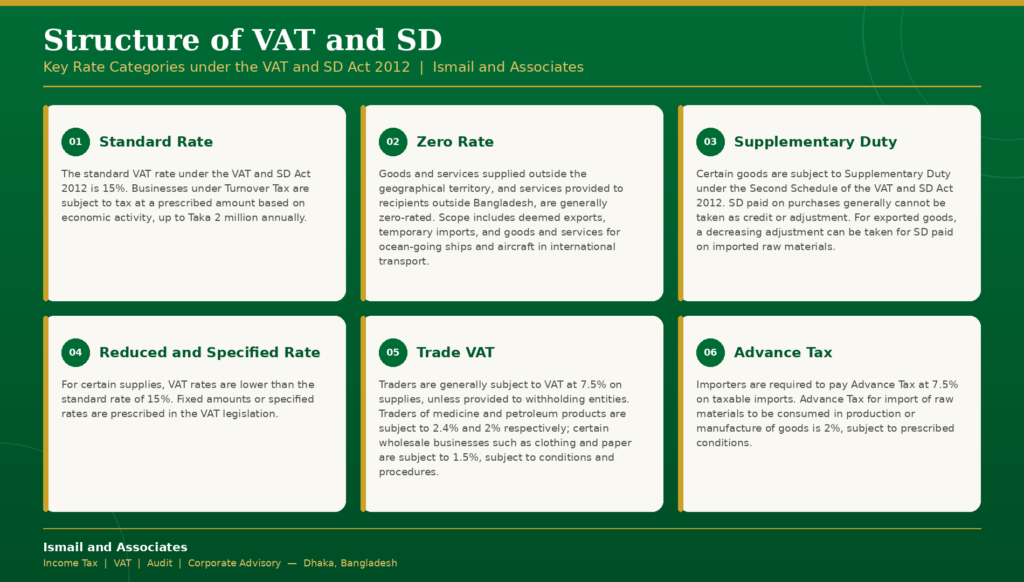
- Standard rate : The standard VAT rate under VAT & SD Act 2012 is 15%. Businesses under Turnover Tax will be subject to tax at prescribe amount based on economic activity (up to Taka 2 million) annually.
- Zero rate : Goods and services supplied outside the geographical territory and services provided to recipients outside of Bangladesh are generally zero-rated VAT. Scope of zero-rated VAT services includes deemed exports, temporary imports and goods and services for ocean going ships and aircraft engaged in international transport
- Supplementary duty ; Certain goods are subject to supplementary duty under Second Schedule of the VAT & SD Act 2012. Generally, SD paid on purchase of goods and services cannot be taken as credit/adjustment. Only in case of exported goods, if any SD is paid on import of raw materials, a decreasing adjustment can be taken
- Reduced and specified rate ; For certain supplies, VAT rates are lower than the standard VAT rate of 15%. Fixed amount or specified rates are prescribed in the VAT legislation.
- Trade VAT : Generally, traders are subject to VAT at a rate of 7.5% on their supplies, unless it is provided to withholding entities. Traders of medicine and petroleum products are subject to VAT at 2.4% and 2%, respectively and for some specific wholesale businesses (e.g. clothing business and paper business) applicable VAT rate is 1.5%, subject to fulfilment of certain conditions and procedures.
- Advance tax : Importers are required to pay Advance Tax at 7.5% on taxable imports. Advance Tax (AT) for import of raw materials to be consumed in the production/manufacture of goods is 2%, subject to fulfilment of prescribed conditions
VAT mechanism
Businesses are required to compute its net VAT payable upon consideration of input VAT credit, if any, and necessary increasing/decreasing adjustments with output VAT
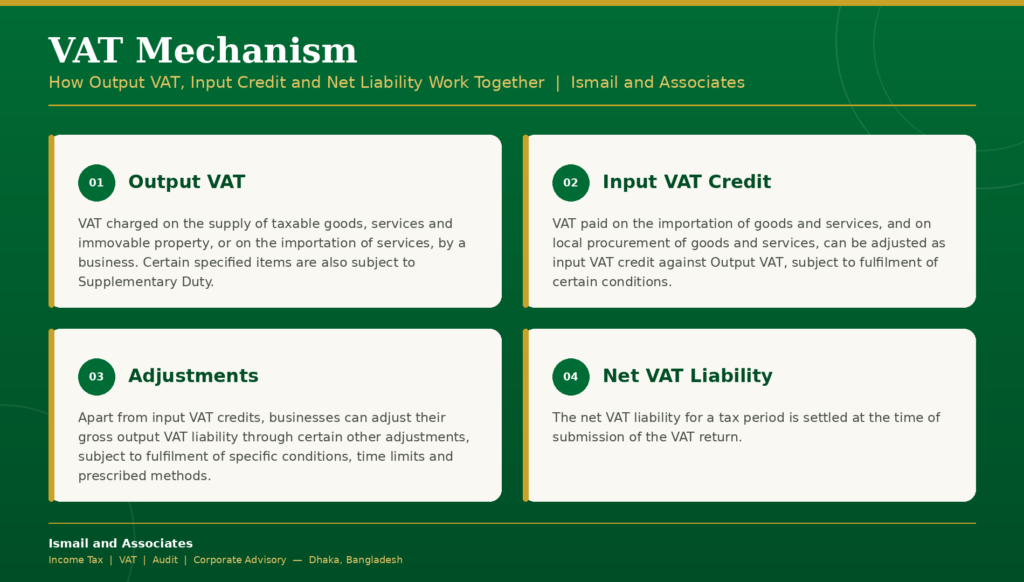
VAT mechanism
- Output VAT : VAT charged on the supplies of taxable goods, services and immovable property or importation of services by a business. Certain specified items are subject to SD
- Input VAT Credit : VAT paid on procurement of inputs for importation of goods and services, and local procurement of goods and services can be adjusted as input VAT credit against Output VAT subject to fulfilment of certain conditions.
- Adjustments :Apart from input VAT credits, businesses can adjust their gross output VAT liabilities with certain adjustments, subject to fulfilment of specific conditions, time limit and method.
Net VAT liability : Net VAT liability of a tax period is settled at the time of submission of VAT returns.
Output VAT ; Output VAT on supplies made by business is structured under 15% standard VAT, Zero-Rated VAT and reduced/ specified rate VAT.
Input VAT and credit ;
Input VAT credit is only obtainable against standard rated and zero-rated VAT supplies. Business entities whose supplies are subject to VAT rates other than Standard and Zero rates can choose to exercise the standard VAT rate of 15% and claim input VAT credit. Input VAT credit is allowed subject to certain conditions, for instance:
• payments by banking channel for any supply exceeding Taka 100,000 except for inter-company raw material purchases;
• report imported services as output VAT in the VAT return of relevant tax period;
• input tax credit should be taken within the next six months from the end of month of purchase or invoice date or goods declaration;
• recording purchase in the prescribed purchase register;
• obtain VAT invoice (Mushak 6.3) against supplies;
• inputs must be declared in Input Output Coefficient by manufacturers/suppliers of goods. Revised declaration must be submitted if total input cost changes by more than 7.5%;
• no input credit can be claimed against supplies subject to supplementary duty; and
• input VAT credit up to output VAT amount if sale price is less than the total input cost; and
• VAT paid against supplies subject to 15%VAT based on actual value addition
Partial input VAT credit ; Input VAT credit is eligible partially only up to the amount of consideration paid or payable for the inputs.
- Decreasing adjustment of issuing credit note;
- Any other prescribed increasing or decreasing adjustment
- Decreasing adjustment for obtaining VAT registration
When businesses supplying goods or service applying different applicable VAT rates (such as standard rate, zero rate, reduced rate or specified rate), input VAT credit is to be calculated in proportion (partial input VAT credit) against those supply of goods or service delivered at standard rate or zero rate.
Documentation for input VAT credit :
Businesses should preserve the following documents against claim of input VAT credit at the time of submission of VAT return:
- For imported goods, goods declaration;
- For local procurement, VAT invoice (Mushak 6.3);
- For imported services, treasury deposit copy for payments of VAT; and
- For utilities, invoice issued for gas, water, electricity, banking, insurance, port and telephone services by authorised entity.
- Invoice raised by banks, mobile financial service providers and digital payment gateways against electricity bill paid by the customer will be considered as VAT invoice (i.e. Mushak – 6.3)
Adjustments of VAT : Apart from input VAT credits, businesses can also take certain adjustments, for instance:
- Increasing adjustment for VAT withheld by the business;
- Decreasing adjustment for VAT withheld by the customer upon collection of withholding VAT certificate (Mushak 6.6) within stipulated time;
- Decreasing adjustment for advance VAT;
- Increasing or decreasing adjustment of under payment or over-payment of VAT amount of any previous tax period;
- Increasing adjustment of interest, penalty, fine, fee and outstanding VAT;
- Increasing or decreasing adjustment of annual recalculation or change in the VAT rate;
- Increasing adjustment of goods used for private purposes;
- Increasing adjustment of VAT on supplies not made through banking channels
Carry forward and refund : Negative net tax payable (refund) for a tax period can be carried forward for six tax periods. If the refund is not fully adjusted and the refund amount is greater than Taka 50,000, it can be claimed as cash refund within three months after making an application. Otherwise, refund can be carried forward until it becomes nil. Refund can be claimed only after submission of all VAT returns up to the current tax period. Exporters can claim cash refund of supplementary duty paid on raw materials import (not applicable for local supplies) immediately
VAT on imported services : Banks remitting payments against importation of services from outside of Bangladesh ensures deposition of applicable VAT to the Government exchequer based on service recipient’s VAT registration status.
- VAT unregistered recipient (B2C): banks will collect VAT at 15% on the import price from the service recipient at the time of making payment to outside Bangladesh and deposit it to Government exchequer.
- VAT registered recipient (B2B): recipient will deposit the VAT to Government exchequer and submit a copy of the treasury receipts to the bank. Otherwise, the bank will collect the required amount of VAT from the service recipient to deposit the VAT to the Government Exchequer in favour of the service recipient.
Treasury receipt of VAT deposition by banks are considered as VAT invoice (Mushak 6.3) for the service recipient who will present this along with their VAT return
Base for VAT, AT and SD imposition :
- General supplies :Consideration for the supply reduced by the tax fraction. Tax fraction: R 100+R Supplies are thus deemed to be VAT inclusive
- Imported Goods ; VAT and Advance Tax(VAT) is paid on sum of: Customs assessable value and Customs duty, supplementary duty, regulatory duty and other duties. Supplementary duty is paid on sum of: Customs assessable value and Customs duty, regulatory duty and other duties
Withholding VAT:
Scope of withholding supplies : Withholding requirement apply on specified 45 service categories as per the VAT Deduction and Collection Rules, 2025. Certain supplies are exempted from VAT deduction requirements.
Supply of goods by a manufacturer: No withholding requirement regardless of the VAT rate. Supply of goods by traders: The entire VAT amount must be withheld, unless the goods are supplied at 15% VAT along with Mushak 6.3 and VAT honour card. Services not subject to withholding VAT: No withholding requirement on services not included in the list of mandatory withholding VAT if Mushak 6.3 is provided. Supply of certain utilities: No withholding requirement on fuel, gas, water (WASA), electricity, telephone, mobile bill. Registered start-ups: No withholding requirement on supplies by registered start-ups. Contract manufacturers: No withholding requirement provided VAT Invoice (Mushak 6.3) is raised by applying 15% VAT. Supply of furniture by manufacturer: No withholding requirement from furniture manufacturer if supplied at 15% VAT by issuing Mushak 6.3 attested by revenue officers. Supply of goods through Electronic Fiscal Device (EFD): No withholding requirement if invoice has been issued through EFD/Sales data controller (SDC) mentioning the name and VAT registration number of the customer/buyer.
VAT filings :
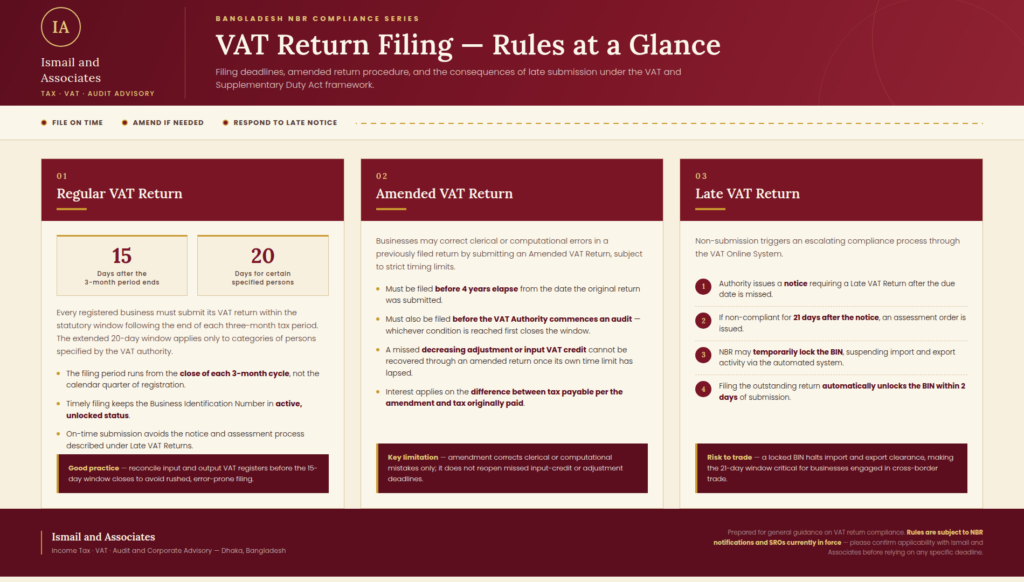
- VAT returns should be filed within 15 days following the end of every three month period (20 days for certain persons).
- Amended VAT Returns: Businesses can file Amended VAT Return for clerical or computational errors. Amended VAT Return can be submitted before the completion of 4 years from the date of filing of the relevant return or before commencement of audit by VAT Authority.Any failure in taking decreasing adjustment or input VAT credit within stipulated time frame cannot be rectified by amended return.The taxpayer will have to pay interest on the difference between the amount of tax payable as per the amended return and the amount of tax initially paid.
Late VAT Returns : VAT authority will issue a notice if a business fails to submit the VAT return in due time and require filing of a Late VAT Return.If any business remains non-compliant after 21 days of the notice, VAT official will issue an assessment order. NBR may further temporarily lock the BIN including suspension of import and export activities through automatic VAT online system. With submission of VAT return, BIN (VAT registration) will automatically be unlocked within two days of the submission
Input-output co-efficient :
All registered persons engaged in the supply of taxable goods are required to submit an input output coefficient declaration to the relevant divisional VAT office within 15 days of making their first taxable supply.
Service providers, 100% exporter/deemed exporters, super shops, online goods sellers and traders supplying at 15% VAT with more than 50% value addition are not required to submit input-output co-efficient declaration
Changes of total input cost more than 7.5% required the registered entity to resubmit the revised input-output co-efficient declaration. If not submitted, additional input VAT above 7.5% of input VAT is to be cancelled.
For supply based on actual value addition basis of exempted or reduced rate manufactured goods, new input-output co-efficient (Mushak 4.3.1) must be submitted.
VAT audit and appeals :
VAT Investigations : VAT audits are performed through frequent inquiries and investigations on matters such as reconciling VAT returns with audited financial statements and focusing on expenses for withholding VAT obligations. Thus, audited financial statements are also key documents for VAT audits. VAT audits are usually conducted for 5 years at a time. Upon completing their inspections, the VAT authority issue notices of demand.
Notable VAT authorities that conduct audits and investigations are Customs, Excise and VAT Commissionerate office, VAT Audit, Investigation, and Intelligence department, Central Intelligence Cell (CIC) and Auditor General (AG) through the concerned VAT circle or divisional office.
VAT audits and investigations are also specially initiated for e.g. closure of business, requesting a No Objection Certificate (NOC) for any business purpose, changing address from one Commissionerate office to another, transfer of business or claiming a VAT refund through an application.
All relevant documents need to be submitted within two months (which can be extended for one month under reasonable grounds) of appeal. Failure to do so can result in best judgment assessment.
Appeal to the Commissioner (Appeal) :
Applicant: Any person or any VAT officer who is aggrieved by a decision taken or order issued under the VAT regulation by any Additional Commissioner or any VAT officer below the rank of an Additional Commissioner
Timeline: Appeal must be made within 90 days from the date of the service of such decision. It can be extended another 60 days subject to certain conditions.
Deposit of tax at the time of filing: 1% of the tax specified in the impugned order (excluding any fines) must be paid at the time of filing.
Disposal of the case: The Commissioner (Appeal) will dispose of the appeal within a period not exceeding one year
Appeal to Appellate Tribunal :
Applicant: Any person or any VAT officer who is aggrieved by a decision taken or order issued under the VAT regulation by any Commissioner or Commissioner (Appeal) or Director-General or by any VAT officer holding the same rank.
Timeline: Appeal must be made within 90 days from the date of the service of such decision. It can be further extended another 60 days subject to certain conditions
Deposit of tax at the time of filing: 1% of the tax specified in the impugned order excluding any fines) must be paid at the time of filing.
Disposal of the case: If the Appellate Tribunal will dispose of the appeal within a period of two years
ADR: Businesses can apply to ADR during Appeal to Commissioner (Appeals) Tribunal or High Court. Decisions of ADR cannot be appealed.
High Court: Taxpayer can file a reference petition in cases of interpretation of the law by depositing 2% of VAT demand
VAT obligations
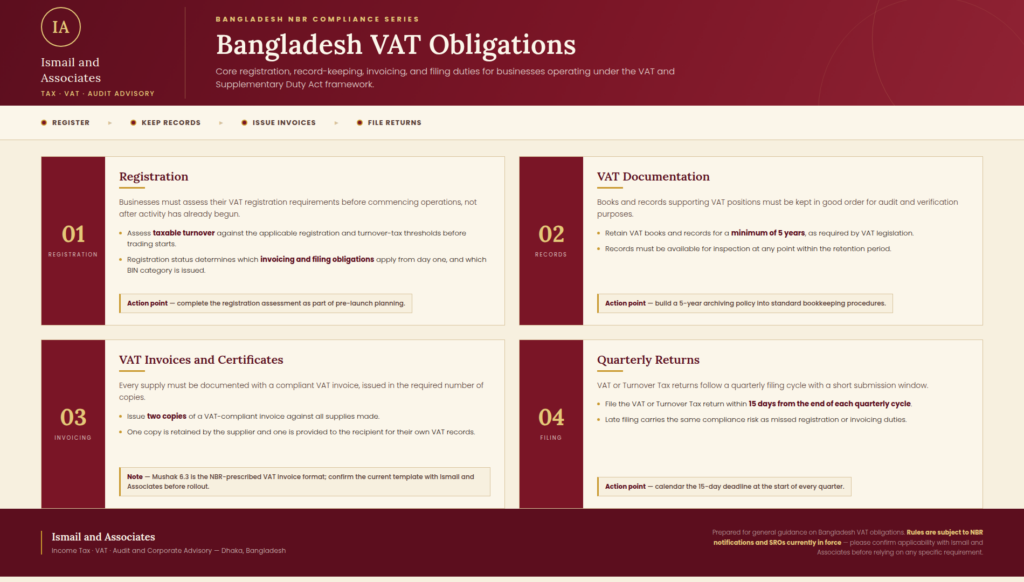
- Registration : Businesses need to assess their registration requirements prior to commencing operations
- VAT documentation : Businesses must maintain books and records as required by VAT legislation for a minimum of 5 years
- VAT invoices and certificates : Businesses must issue two copies of VAT compliant VAT Invoices (Mushak 6.3) against all its supplies
- File quarterly returns ; Businesses must file VAT or Turnover Tax returns within 15 days from the end a quarterly cycle
VAT obligations :
Registration : Businesses need to assess their registration requirements prior to commencing operations.
A business should register for VAT, if:
1.mandatory registration rules apply (currently 175 specific goods and services are subject to this requirement) through general order;
2. it’s annual turnover exceeds Taka 5 million;
3. supplies are subject to supplementary duty;
4. it is participating in contract, tender or work order;
5. it is an importer or exporter;
6. it is a foreign branch, liaison or project office;
7. it is a VAT agent; or
8. it is required to submit proof of VAT registration.
Businesses falling outside the above scope needs to enlist for turnover tax if annual turnover exceeds Taka3 million. Otherwise, no registration or enlistment requirements is applicable
VAT documentation : Businesses must maintain books and records as required by VAT legislation for a minimum of 5 years
Business can maintain all prescribed books and records at its own format or template covering all the prescribed information
Businesses must prepare their financial statement under IFRS and have them audited as per ISA. For tax determination, all documents which depict the operation of business should be considered
In case of unsettled VAT disputes, all the relevant documents and records must be kept until the settlement of such disputes
All suppliers of goods are required to file Input Output Co-efficient in Mushak 4.3 online and to the divisional VAT official within 15 working days from date of first supply
VAT invoices and certificates ; Businesses must issue two copies of VAT compliant VAT Invoices (Mushak 6.3) against all its supplies
Businesses can design its commercial invoice to be treated as VAT invoice by including all prescribed information in Mushak 6.3.
VAT Invoice or Mushak 6.3 can be issued through registered entity’s ERP system. Preservation of electronic VAT Invoice or Mushak 6.3 is allowed. In case of mobile financial services, online notifications or statements can be treated as VAT Invoice or Mushak 6.3.
Moreover NBR, by a notification in the official Gazette, can declare any Tax Invoice or bill issued by a registered person in his/her own format as a Tax Invoice (i.e. Mushak 6.3).
Withholding entities must issue withholding VAT certificate (Mushak 6.6) in prescribed format for any VAT withheld or deducted against its payments
Unregistered businesses must issue withholding VAT certificate (Mushak 6.6) within 3 working days from depositing withheld VAT to the Government exchequer.
Registered businesses must issue withholding VAT certificate (Mushak 6.6) within 3 working days from the date of submission of VAT returns.
File quarterly returns : Businesses must file VAT or Turnover Tax returns within 15 days from the end a quarterly cycle
Returns can be filed within 20 days from the end of a quarterly cycle for Government, semi-government and autonomous organisations, banks and insurance companies or in case of submission of zero/nil VAT return.
Voluntarily monthly VAT return filing is allowed on any day following the end of month
If the last day for the submission of VAT return is a “public holiday”, the next working day will be considered as the deadline for the submission of VAT return.
An extension of up to one month can be taken for filing VAT return by paying delay interest of 1% per month on the net VAT payable after obtaining approval from the VAT authority (interest may be waived at the discretion of VAT authority)
Supplementary duty reporting is now integrated within the VAT return
Companies must submit their audited financial statements within 6 months after the end of each financial year (6 month further extension subject to approval of Commissioner
Other matters
- Operating from multiple locations ; Businesses operating across multiple locations and offering a variety of goods and services may be subject to either central or unit-based VAT registration, depending on their specific circumstances.The existence of separate business units is not the primary factor in determining eligibility for central VAT registration. Rather, the key consideration is whether the organisation maintains its books and records at a central location.Where a business is centrally registered, supplies made between its units do not give rise to output VAT liabilities, nor do they generate entitlement to input VAT credits.
- VAT on sale of business : Where any business or part thereof is purchased or transferred with an intention of continuing the economic activities, such transfer of ownership will not be regarded as a taxable supply.Prior approval of the VAT authority is needed.
- VAT software : VAT registered businesses with an annual turnover exceeding Taka 50 million in the preceding financial year are required to maintain their VAT related books and records using software prescribed by the VAT authority. To comply, businesses must either:Use software developed or supplied by NBR approved vendors, orUse their own enterprise software, provided it meets the technical specifications prescribed by NBR.VAT registered entities can maintain VAT Invoice (Mushak 6.3), Purchase Register (i.e. Mushak 6.1), Sales Register (i.e. Mushak 6.2) and Combined Purchase and Sales Register (i.e. Mushak- 6.2.1) through the company’s ERP software system without prior approval from the concerned authority
- Fair market price rules ; Fair market price rules apply on supplies such as:
- Taxable supplies made without consideration or for inadequate consideration;
- Distribution of free samples exceeding Taka 50,000 in a fiscal year;
- In-kind benefits to any employee without a consideration or at a price less than the fair market price;
- Unaccounted quantity of goods subject to SD identified during a VAT audit;
- Transfer of immovable property by a property developer to the landowner;
- Transactions between associated entities will be based on the fair market value of the taxable supply or imported services if:
- The taxable supply or imported service is made without consideration or at a value below fair market value, and
- The recipient associated entity cannot claim input VAT credit on the taxable supply or imported service.
Special VAT regimes :
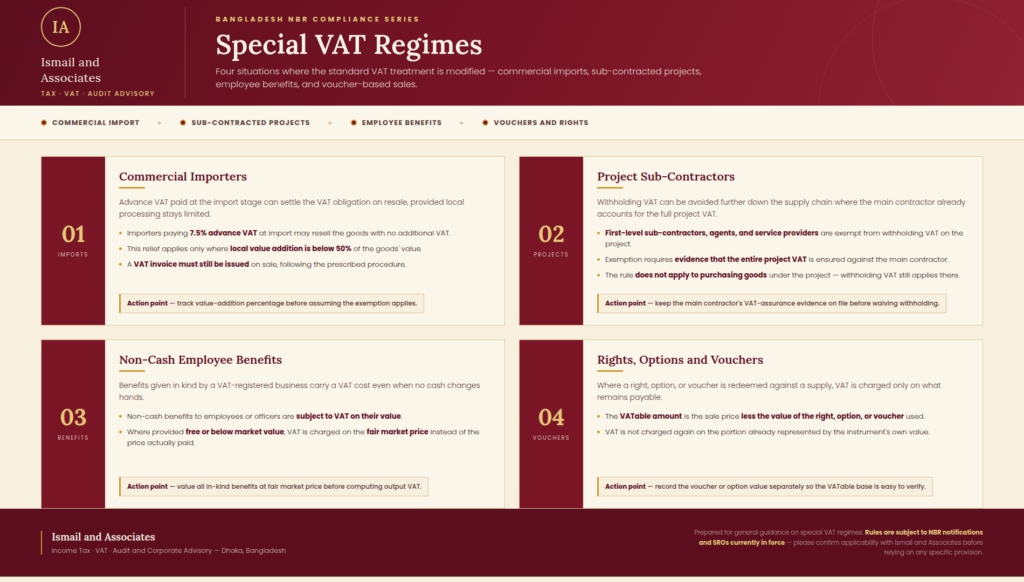
- 1.Commercial importers who pay 7.5% advance VAT at the import stage can sell imported goods without additional VAT if local value addition is less than 50%. They must issue a VAT invoice following the prescribed procedure
- 2.First level sub-contractors, agents or any other service providers in a project are not subject to withholding VAT on the basis of evidence that payment of entire VAT of the project is ensured against the main contractor. This rule is not applicable for purchasing goods under the project
- 3.Non-cash benefits to employees or officers provided by VAT registered business are subject to VAT based on their value or fair market price if they are provided free or below market value.
- 4.When a right, option or voucher is used, the VATable amount is the remaining amount after subtracting the right, option or voucher’s value.
Supplies of exempted or reduced VAT goods : Business can supply of locally manufactured goods that are VAT exempted or reduced VAT rated, by applying 15% VAT on the value addition by it, provided VAT invoices of previous supply (i.e. purchases) is obtained and the business has duly filed new input-output co-efficient declaration form (Mushak 4.3.1) with the VAT authority..
Proof of VAT registration : Businesses must submit valid proof of registration, i.e. VAT registration (BIN), for following activitiesOpening and operating a current account or short term deposit account with any bank, NBFI or any other financial institution;
• Obtaining a loan from any bank, NBFI or any other financial institution;
• Renewal of a trade license;
• Opening a merchant account for any mobile financial services (MFS) Obtaining or renewing membership of a trade organization;
• Obtaining electricity and gas connections in the name of an enterprise; and Obtaining vehicle registration from the BRTA in the name of a business enterprise.
Surcharges :
Health development surcharge is imposed on imported and manufactured tobacco products at 1% on the value of the supply.
Environment protection surcharge is imposed on goods produced by environment polluting industrial enterprises at 1% on the value of the supply
Information and communication development surcharge is imposed on imported and manufactured cellular mobile telephone devices at 1% on the value of the supply.
Development surcharge is imposed at 1% on mobile calls through SIM
A VAT Return is the quarterly statement that every VAT-registered person submits to the National Board of Revenue (NBR) declaring taxable sales, purchases, input tax, output tax, VAT payable or refundable, and other VAT-related information for the tax period. Under the current VAT system, returns are primarily filed through the NBR’s online platform using the prescribed VAT return form (Mushak-9.1).
1. Legal Framework
- Value Added Tax and Supplementary Duty Act, 2012 (as amended)
- Finance Act, 2026
- Relevant VAT Rules, General Orders (GO), and SROs issued by NBR
2. Who Must Submit a VAT Return?
A VAT return must generally be submitted by:
- VAT-registered manufacturers
- Importers
- Exporters
- Traders
- Service providers
- Any other registered VAT person
Even if there is no business transaction during a month (Nil Return), a registered person is generally required to submit the monthly VAT return.
3. Tax Period
- One calendar month.
4. Due Date
The VAT return must generally be submitted within the 15th day of the following month. If the 15th falls on a public holiday, filing is generally required on the preceding working day.
5. VAT Return Form
- Mushak-9.1 – Monthly VAT Return
- Turnover taxpayers use Mushak-9.2, where applicable.
6. Information Required
Before filing, collect:
- Sales Register
- Purchase Register
- Tax Invoices
- Credit Notes
- Debit Notes
- Import Documents
- Export Documents
- Treasury Challans
- Electronic Fiscal Device (EFD/SDC) reports (if applicable)
- Previous month’s closing balance
7. Important VAT Registers
Maintain the prescribed Mushak records, including:
- Purchase Register
- Sales Register
- Tax Invoice Register
- Credit Note Register
- Debit Note Register
- Input Tax Register
- Output Tax Register
- Stock Register
8. VAT Calculation
Output VAT = VAT collected on sales
Less:
Input VAT = VAT paid on eligible purchases
Net VAT Payable = Output VAT − Allowable Input VAT ± Adjustments
9. Standard VAT Rate
- Standard VAT: 15%
- Export: 0%
- Other rates or exemptions apply only where provided by law or SRO.
10. Online Filing Procedure
- Log in to the NBR VAT Online Portal.
- Select the relevant tax period.
- Complete Mushak-9.1.
- Enter purchase and sales information.
- Verify input tax credit.
- Calculate net VAT.
- Submit the return.
- Download the acknowledgement receipt.
11. Common Mistakes
- Incorrect BIN
- Wrong tax period
- Invoice mismatches
- Claiming ineligible input VAT
- Missing purchase invoices
- Incorrect VAT adjustments
- Failure to submit Nil Returns
- Late filing
12. Late Submission
Late filing may result in:
- Penalties
- Interest
- Compliance notices
- Additional scrutiny by NBR
Where permitted, an extension may be requested in accordance with the VAT law.
13. Best Practices
- Reconcile VAT monthly.
- Keep invoices properly numbered.
- Maintain digital and physical records.
- File before the deadline.
- Reconcile VAT with financial statements.
- Review input tax eligibility before claiming.
14. Documents to Keep
- VAT Registration Certificate (BIN)
- Tax Invoices
- Purchase Invoices
- Bank Statements
- Import Documents
- Export Documents
- Mushak Registers
- Treasury Challans
- VAT Returns
- Adjustment Documents
15. Practical Compliance Checklist
- ✓ Complete monthly sales register
- ✓ Complete monthly purchase register
- ✓ Verify input tax
- ✓ Verify output tax
- ✓ Prepare Mushak-9.1
- ✓ Pay VAT (if payable)
- ✓ Submit the return
- ✓ Save acknowledgement
- ✓ Archive supporting documents
Conclusion
Timely and accurate VAT return filing helps businesses remain compliant, avoid penalties, maintain eligibility for input tax credit, and strengthen financial governance. Businesses should regularly review changes introduced through the Finance Act 2026, applicable SROs, and NBR notifications before filing each month’s return
RELATED POSTS
View all


A complete cloud bookkeeping Guide — QuickBooks, Xero, payroll, VAT/GST/Sales Tax,
September 17, 2026 | by Mohmmed Ismail Miah